tip-tøp tromsø

After our Scandinavian Interrailing trip last summer, I knew there was one place in Norway I still wanted to see. Somewhere so far north the railway doesn’t reach it, a place where the nearest train station is 230km or 3.5 hours drive to the south. Somewhere within the Arctic Circle, somewhere cold, snowy, dramatic, watery, and with just few hours of daylight (or none at all) in winter.
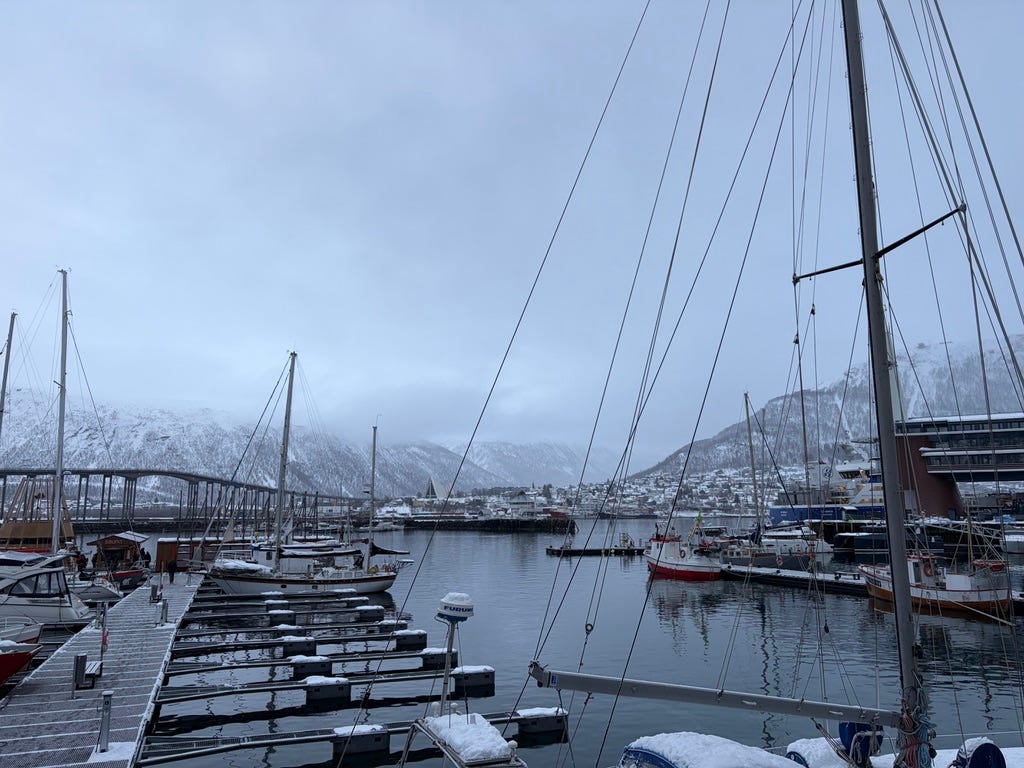
[at the end of the jetty is a sauna and swim which four of our party tried 🥶🥶🥶🥶]
So last weekend we were in Tromsø, a small city (pop. c70k) which is home to the world’s northernmost brewery/McDonald’s/university/professional football team/cathedral (also Norway’s only wooden cathedral),
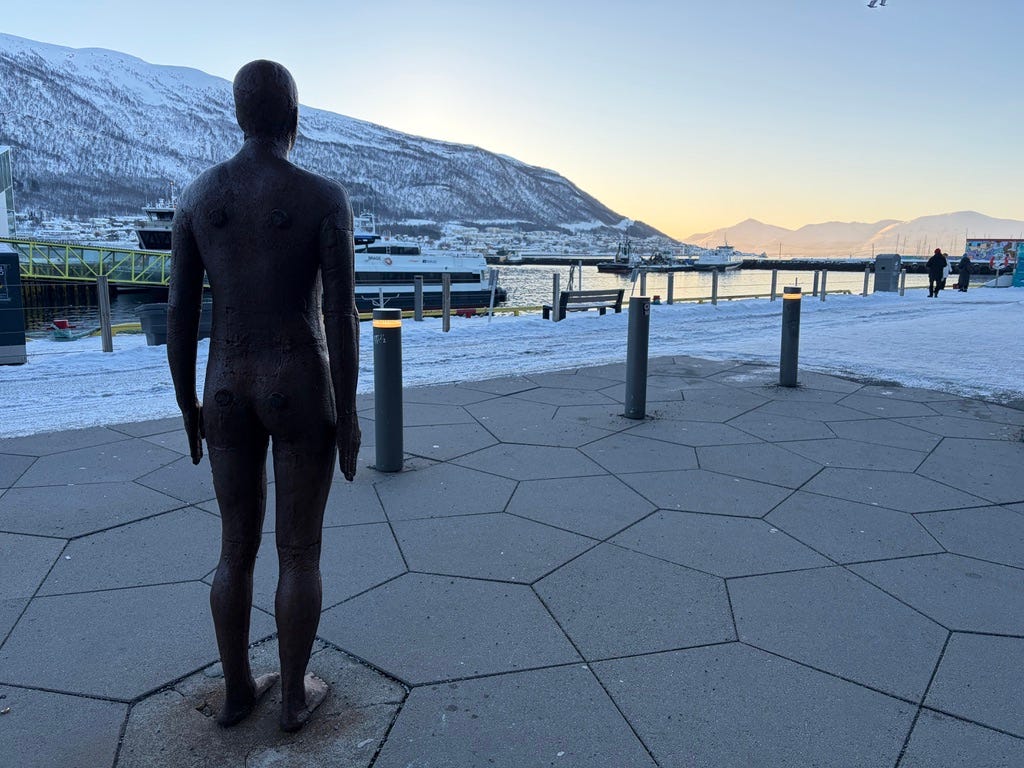
and possibly the world’s northernmost Antony Gormley figure (AG gets everywhere 🤦🏻♀️).
It’s a bit ironic, really, as I hate being cold, but with the accumulated years of reading about polar exploration (mainly Antarctic, to be honest) and imagining what it’s like to live in an inhospitable climate, I was more than ready to see the snow and ice and mountains for real, and well prepared with a properly warm outfit and properly warm footwear.
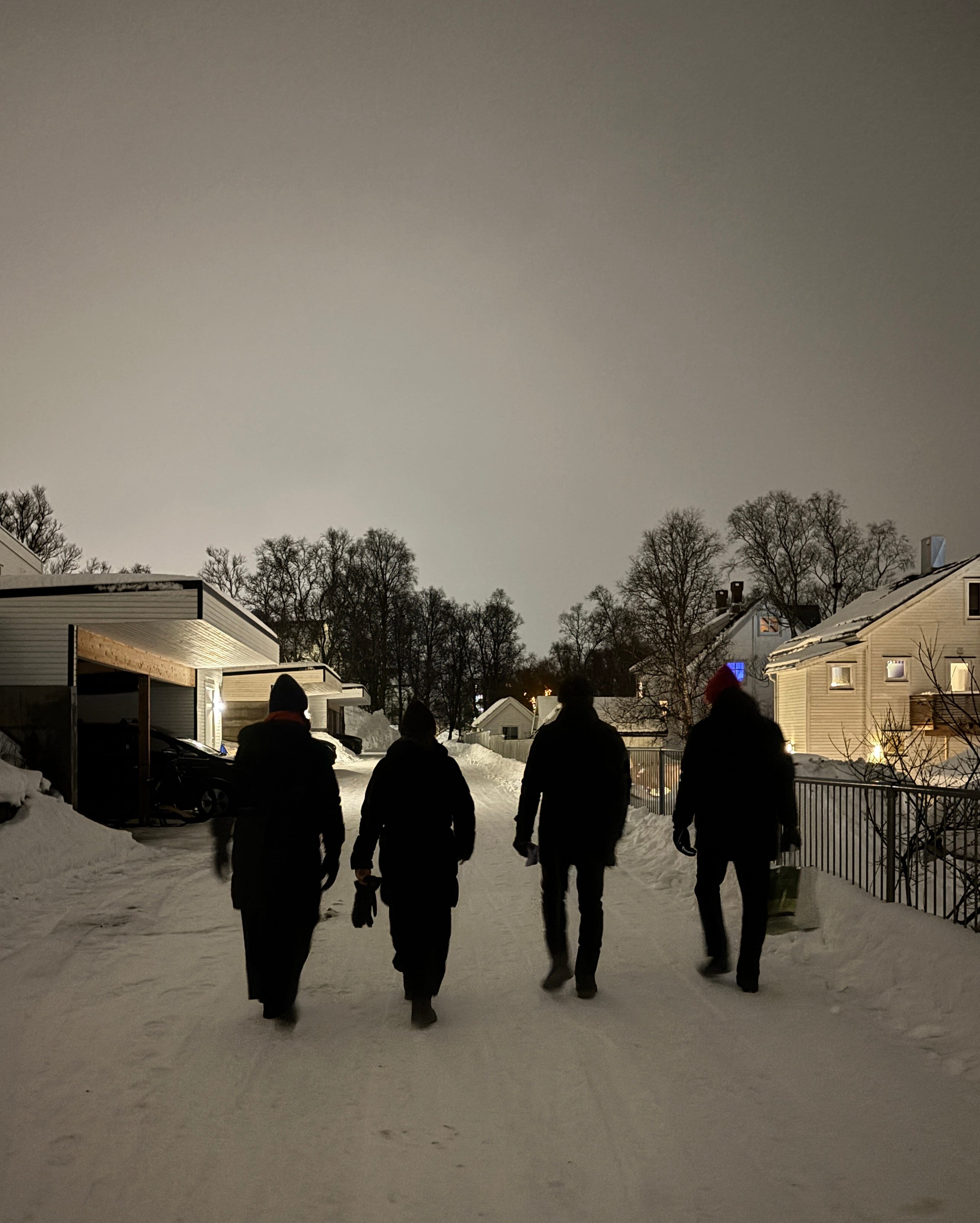
And I can report that the beanies I knitted for everyone - because, to our surprise, Alice and Phoebe and partners were all keen to come as well - did a grand job of keeping heads and ears warm in -10C. (I used one strand Sandnes Garn Double Sunday with one strand Knitting for Olive Silk Mohair. or Sandnes Garn Tynn Silk Mohair).
In the summer, I’d also read Alberta and Jacob (1926) by Cora Sandel, a novel set in Tromsø, and the meteorological, domestic, and emotional coldness were conveyed so vividly that I really wanted to see the town and the house where the author lived for five years (twelve years in total in Tromsø). It’s now the Perspektivet Museum and is still in the centre of town, not far from the harbour and deep fjord, and still mostly surrounded by the painted wooden buildings (now with blue plaques) where her various characters worked and lived.
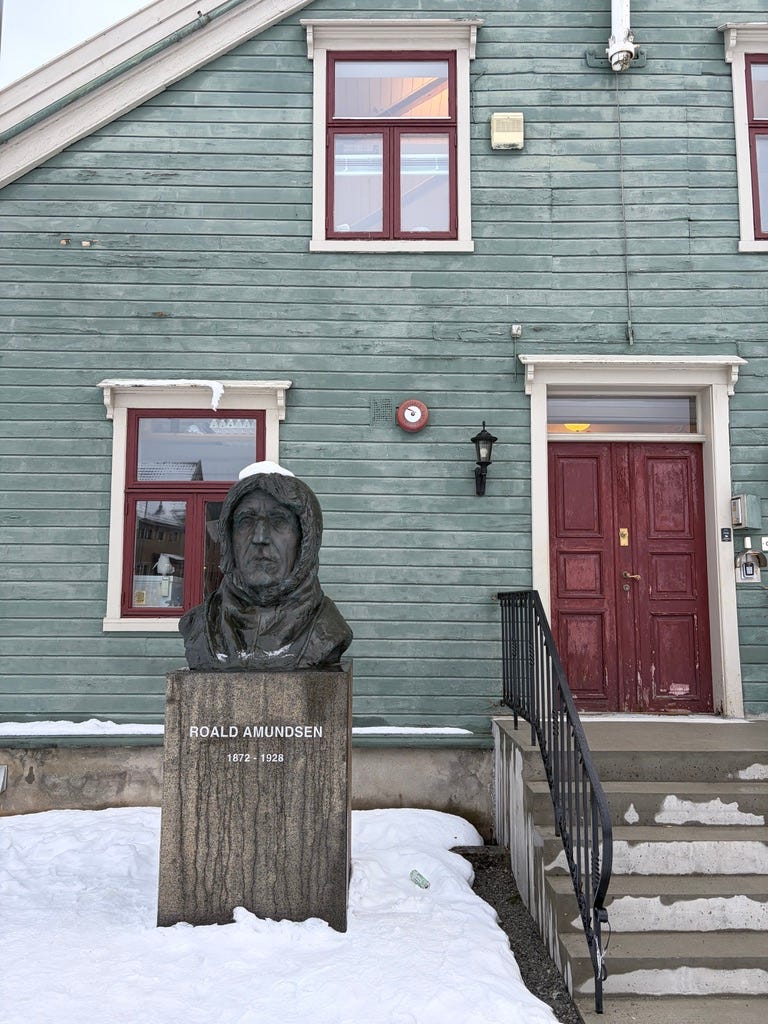
A visit to the Polar Museum was obligatory. It is fantastically old-fashioned, stuffed with polar artefacts, animals, stories, and photographs which would require trigger warnings in Britain but don’t whitewash the history and realities of life in these regions. Outside is a bust of Captain Scott’s nemesis, Roald Amundsen who didn’t play by the British rules of polar exploration which mainly consisted of stiff upper lip, man-hauling, horses which died, and pemmican, whereas he used skis, skills, and dogs, and careful planning and training. He died in 1928 after flying from Tromsø on a search and rescue mission for the airship Italia.
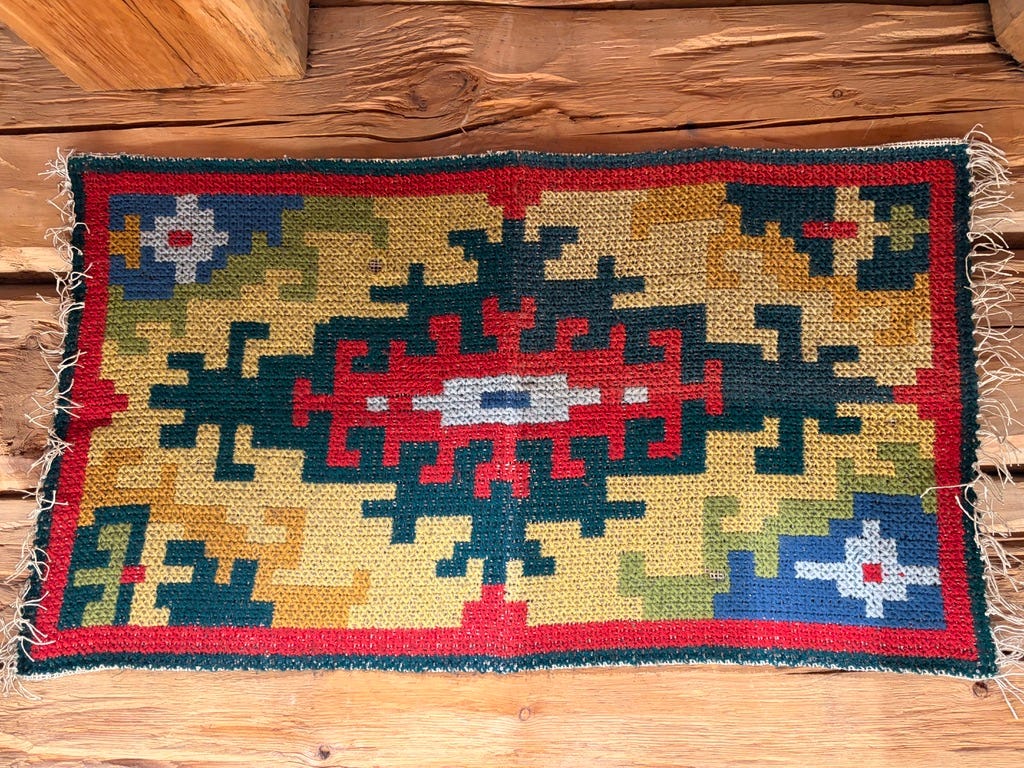
[table runner stitched by Wanny Woldstad]
The museum also has a room devoted to Wanny Woldstad (1893-1959) who in the 1920s was the first female taxi driver in Tromsø and then the first full-time female trapper in Svalbard. According to the museum, she also managed to combine housekeeping, cooking meals, and cross-stitching mats with hunting, trapping, and shooting huge numbers of polar bears (during the 1934-35 trapping season, she baked 770 loaves - up to nine in one batch - and 200 Christmas cookies). Although she shared the domestic chores with her companion, you get the feeling he didn’t embroider or do as much as her.
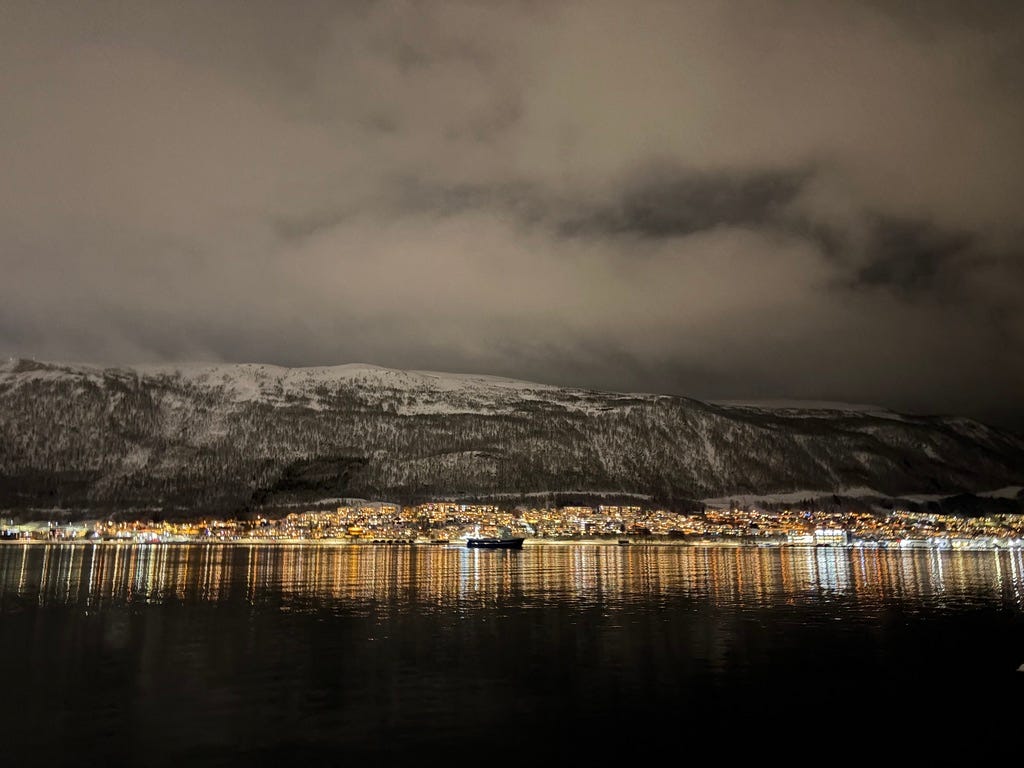
This is exactly the sort of thing I am so curious about: how do you set up shelter and survive in polar regions? Tromsø itself is a C21 success story (but still relies on huge amounts of everyday items being brought in from elsewhere) and from the outside looking in is doing well. The houses and low-rise blocks of flats are a mix of old and new, the lights are on all day and the windows are large to catch all the available light. It huddles together on the opposite edges of the fjord, looks stunning, and there’s plenty happening.
And you can keep warm in modern ways. The swimming pool complex has all sorts of pools including a 50m one,
[Tromsøbadet photo]
but the best bit is just floating in the beautifully warm outdoor pool while admiring the views of mountains and a biathlon course, and watching planes land at the airport (about 3km away as the crow/twin-prop flies) and people zooming around on skis.
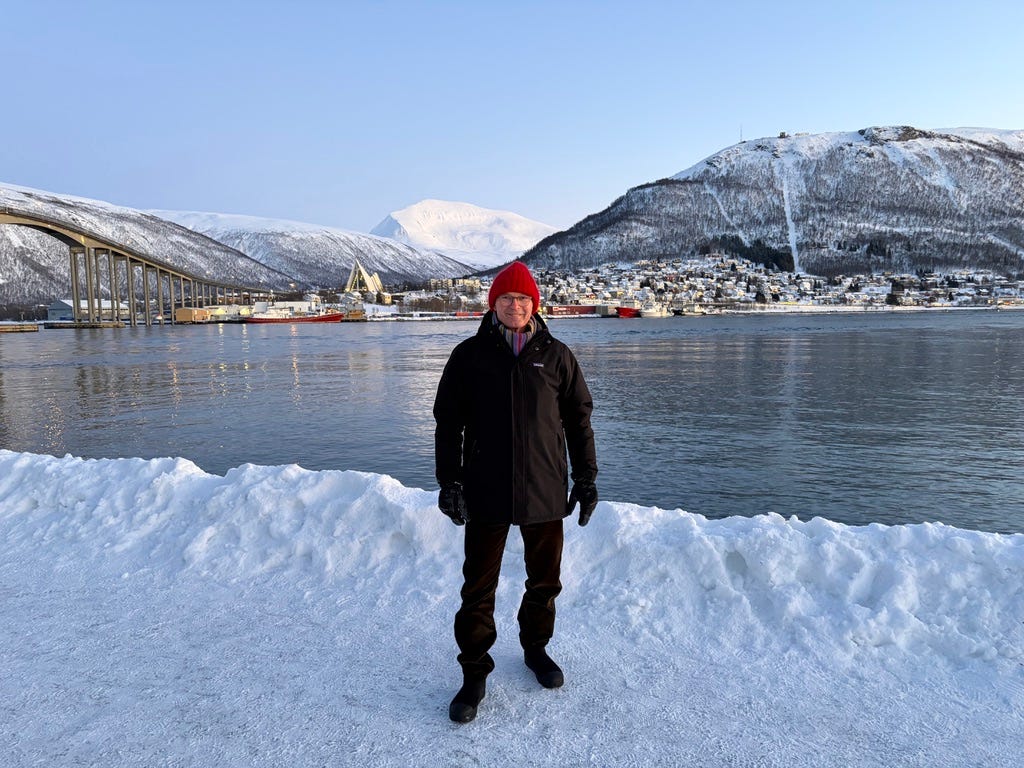
[triangular Arctic Cathedral (1965) in background]
You also need warm woolly jumpers, preferably a lusekofte, but you can always knit your own. Just like all the other towns we’ve visited in Norway, there is a fantastically well-stocked wool shop which required two visits, one to hyperventilate with excitement and take it all in, and one to buy a few balls of Sandes Garn.
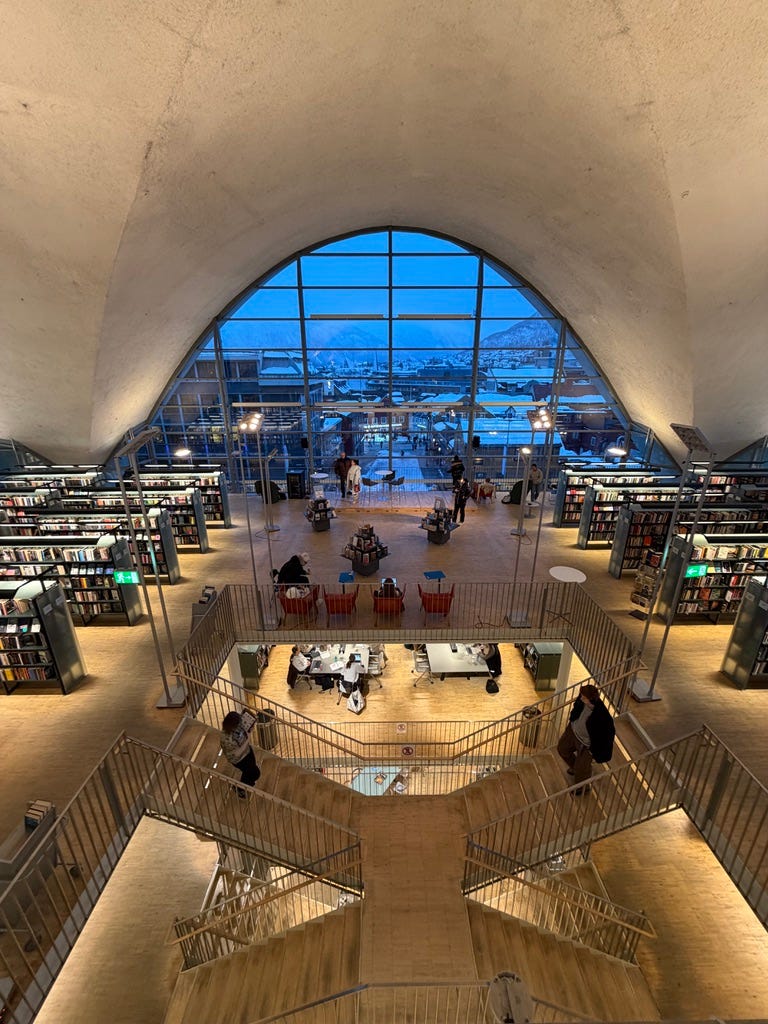
And, as we’ve come to expect in Norway, there is a stunning, contemporary, warm, well-lit library. This one has was converted from a 1960s cinema; they took the futuristic hyperbolic paraboloid shell, inserted glass all the way up to give views over the town and the fjord, and created a phenomenal multi-level interior. Needless to say, it’s full of people reading and working and knitting.
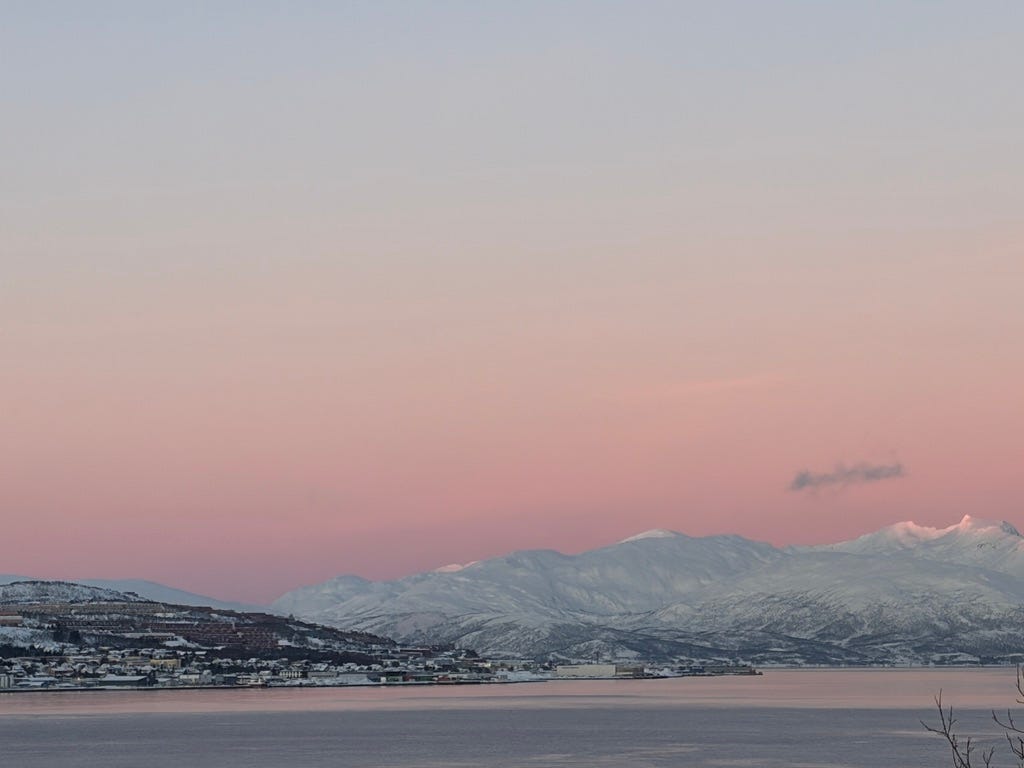
[looking north in the afternoon]
But even with all this warmth and cosiness, and possibly because you know they are there and waiting for you, the cold, the light, the colours, the snow all draw you outside. My favourite polar explorer is Dr Edward Wilson, Scott’s right-hand man, a man of many talents who painted watercolours in Antarctica. I once went to see the collection in Cheltenham at the Wilson Gallery and was struck by the range of tints, the delicacy, and the beauty. To my delight, I caught a Wilsonesque scene of pink peaks and sky, and wondrous fading light.
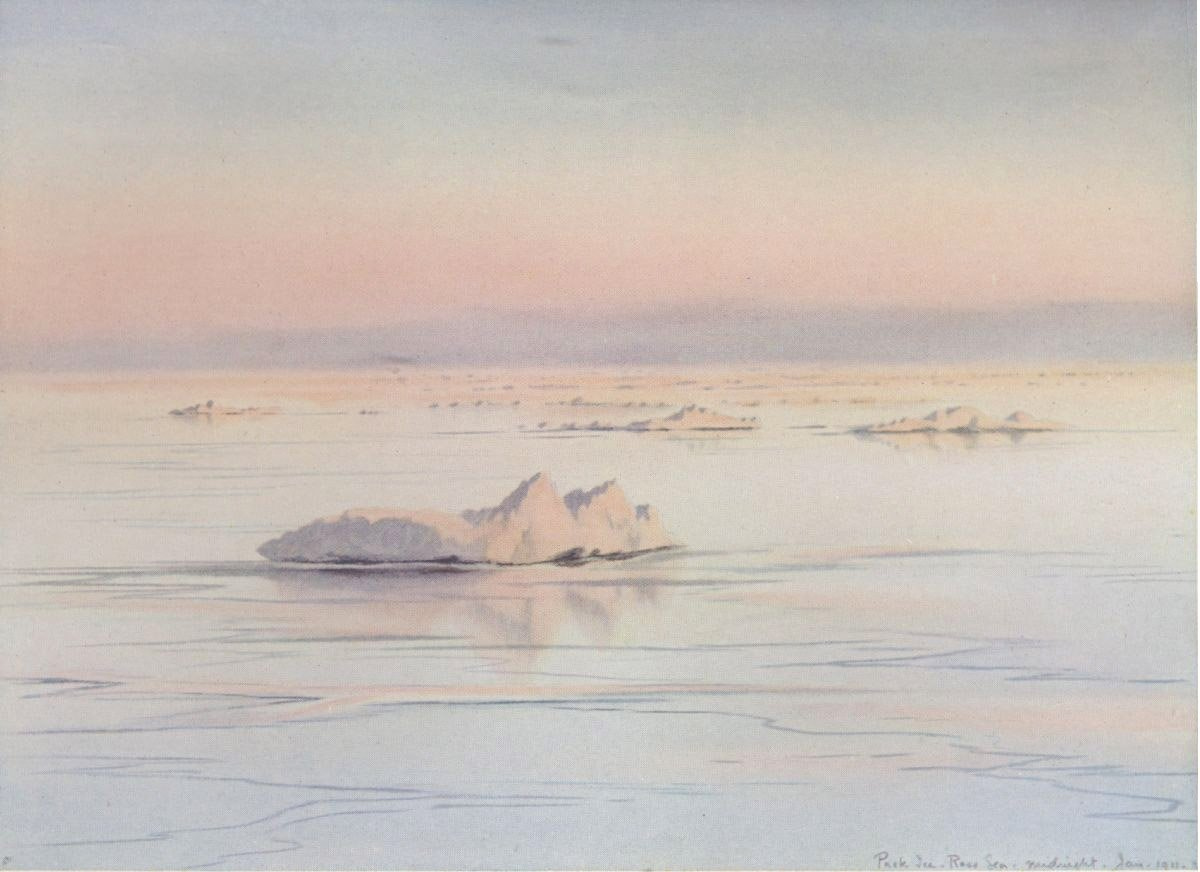
{‘Midnight’ by Dr EA Wilson, painted during the Terra Nova expedition (1910-13) to Antarctica]
Oh yes, the light/s. One of the the reasons Tromsø has experienced a surge in tourism is the Northern Lights and so many people “chasing” them. It’s not what I was there for, but it amused me that you can pay a lot to drive miles - even into Finland - to sit on a frozen lake looking up at the clouds and not see a thing, but you can walk to the supermarket in Tromsø and see this:
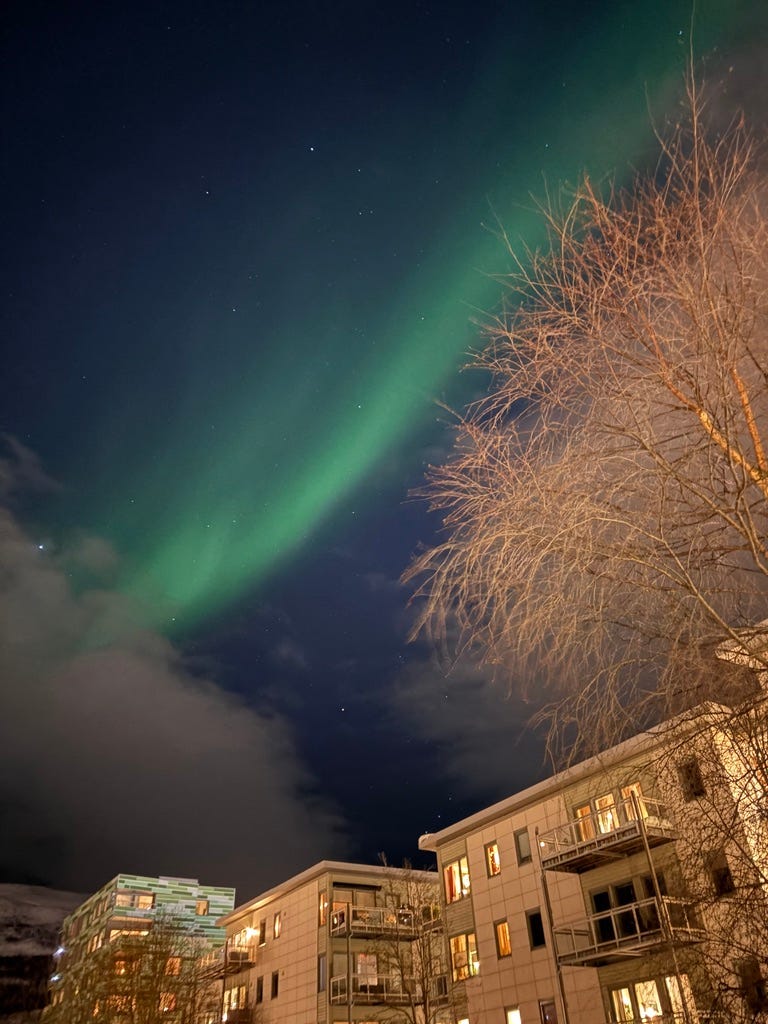
To be fair, a faint aurora is often not obvious. To the naked eye, this just looked like a wispy cloud or vapour trail. It was Alice who spotted the possibility and it was only when we used our cameras that it showed up green.
Like so many places above the Arctic Circle, Tromsø used to take days to reach by packet boat or overland from the south, so it blew my mind that we could leave on an early flight and be back in Cambridge via Gatwick just after midday. But then again we are not proper explorers.
Happy Sunday!
PS I made my own Best Beatles playlist on Simon’s Spotify account to listen to whilst flying along the west coast of Norway with views of its snowy mountains and many of its 239,000 islands. He loves it when The Beatles intrude unannounced via his headphones. Not.
We were in Tromsø the autumn before last as the first snows were falling. The library is a stunning building but is also alongside a good bar where we drank lingonberry cocktails. The loss of all those Polar bears….the hunters of the early 20th century was where the rot set in
Oh Jane, what an amazing post. I have just added a new destination to my list. Thank you for taking me so far out of my comfort zone ( well not yet, but I really, really want to fo this). Next winter.