"some brass and stuff"

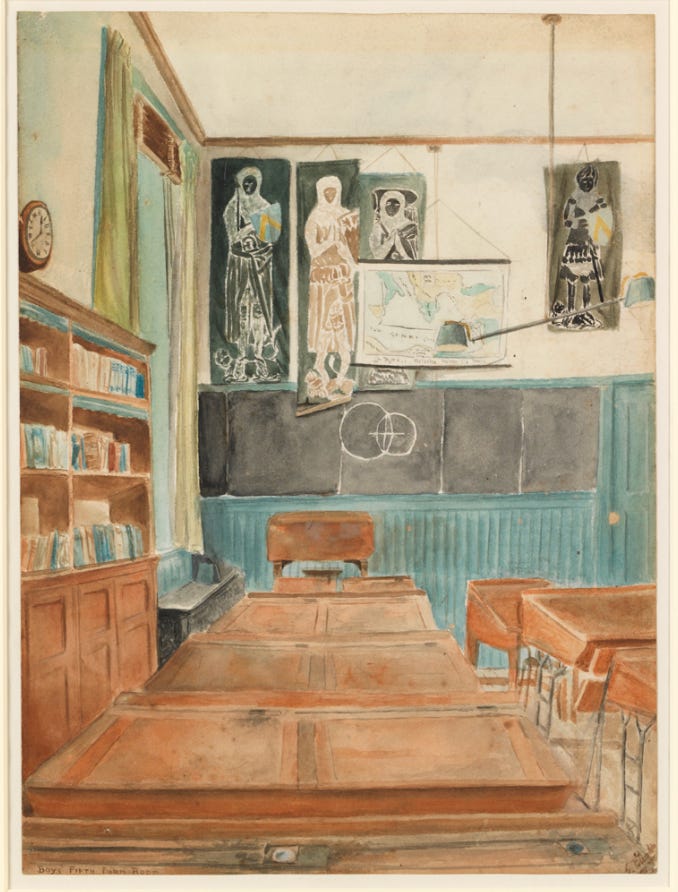
[‘The Boys’ 5th Form Classroom’ (1918) by Edward Bawden]
Earlier this year I got all interested in brass rubbing. I’m not sure where this came from, as it’s the kind of thing I associate with earnest young Cambridge undergraduates in the 1950s in tweed jackets and bicycle clips with their balls of black heelwax and rolls of paper and copies of Pevsner touring the ancient Fen churches on their bikes and making rubbings of the monumental brasses.
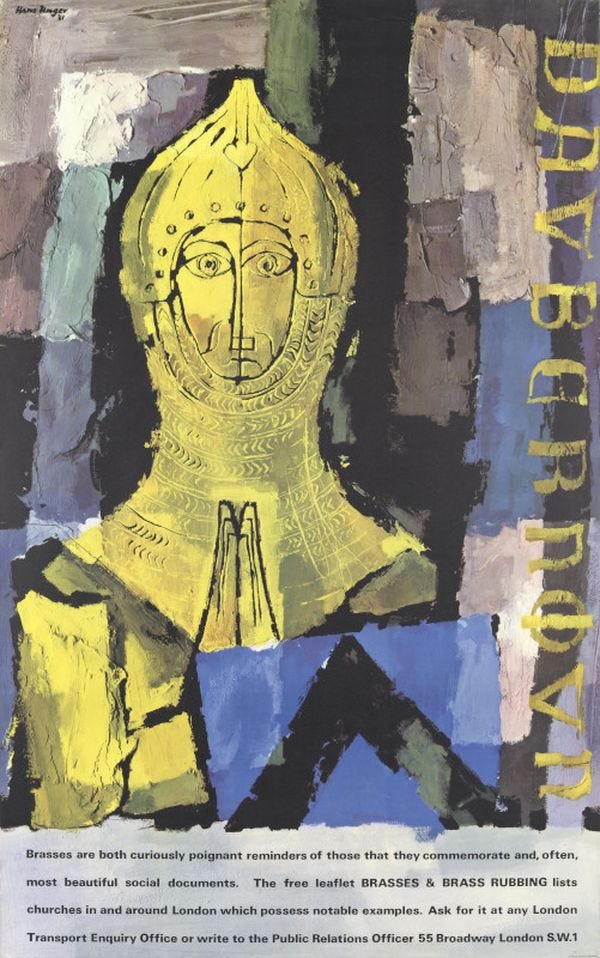
[London Transport poster (1961) by Hans Unger]
Brass rubbings were once ubiquitous, like a TikTok craze but with greater longevity and less brainrot. A wholesome pastime, the sort of thing boys’ grammar schools and public transport encouraged. As in this 1952 film. As in the 1918 painting above by Edward Bawden; in this image, given the date, they are almost memorials to the old boys who are no longer there in the empty classroom. Maybe the question of how to commemorate the dead after the war was what rekindled the Victorian enthusiasm for brass rubbing?

[John Piper photo of brass work at St John the Baptist Church in Shottesbrook, Berkshire]
It certainly influenced a great deal of mid-century design and illustration with its similarly flattened, stylised relief prints, lino cuts, and firm, bold black lines. Much of John Piper’s artistic style, for example, owes a great deal to church brasses and brass rubbings, and the Tate has some of his lovely, beautifully lit photographs which capture the idea of the eternal rest of the people memorialised. As one reviewer of Frances Spalding’s biography of Piper (and his wife, Myfanwy) said, “His reputation…rested on the look he fabricated, a graphic look compounded of stage flats and wizened textures picked out in brass-rubbing black, ceiling white, royal blue and pillarbox red.”
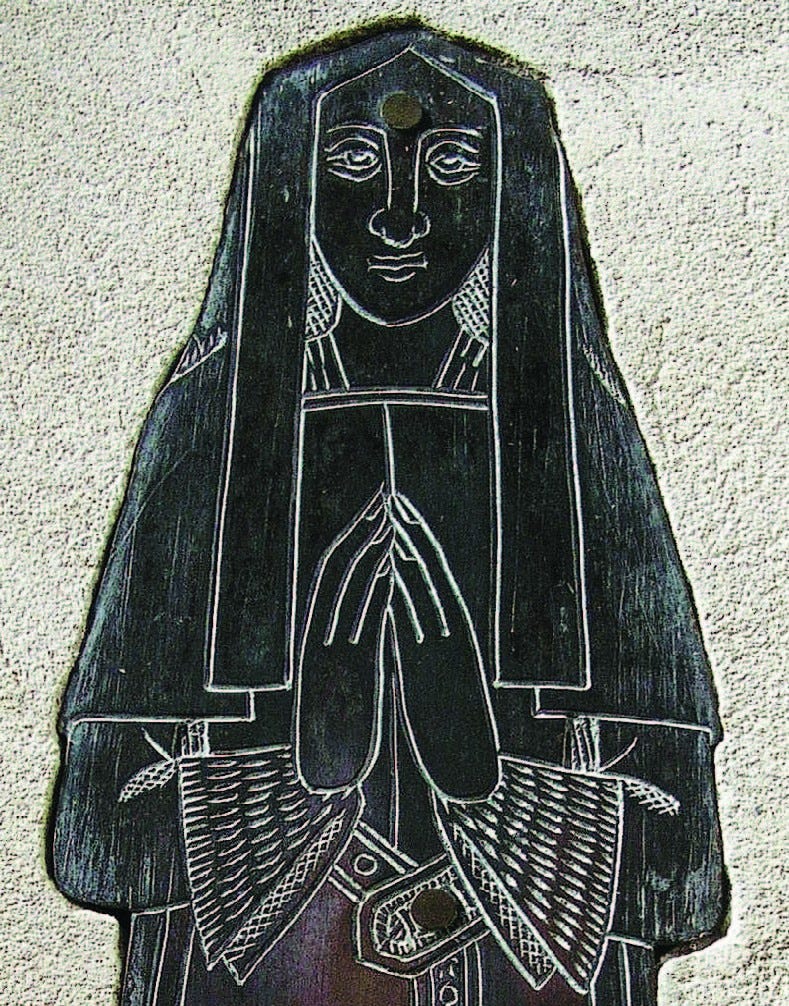
Having realised how much I like both the wonderful, smooth, deeply insiced worn brasses and the negative version a rubbing can produce, I wanted to embark on a church crawl and have a go, but failed almost immediately. Very few churches allow people to do brass rubbings, these days. It damages them, they say, but I think it’s mostly to do with the usual health and safety concerns, since many of the brasses have been there, often underfoot, for centuries, so a bit of light rubbing isn’t exactly going to erase them. Worse still, is the fact that over time many brasses have been removed or stolen, leaving just an imprint in stone or on a wall. This 1518 brass was stolen from Itchen Stoke church in Hampshire in 2020 and is/was a lovely example of the directness and purity of the lines which appeal to me - just look at the lovely hands.
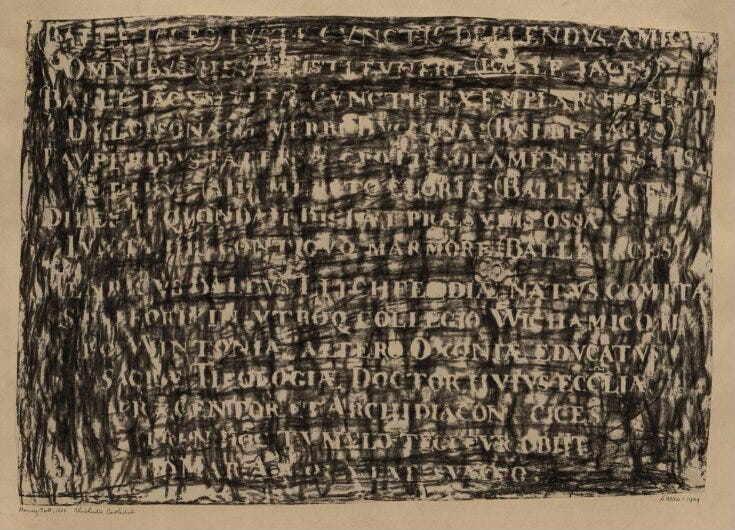
[C19 rubbing of c1603 brass in Chichester Cathedral, in the V&A]
And anyway, I’m sure how I’d feel about being caught in flagrante on my knees on the floor, with a big piece of paper taped over a monumental brass and what would probably look like child’s angry scrawl. Although, tbh I just love this rubbing which the cognoscenti would no doubt tut-tut at; with its wild, energetic marks, it looks incredibly expressive and modern. And although there is skill involved in getting a good brass rubbing, it can all get a bit prescriptive, method-wise. The Monumental Brass Society - which sounds like it belongs with the Village Green Preservation Society in the Kinks 1968 song - tells you to “rub in one direction only (preferably up and down, following the main lines of the engraving)”, instructions the rubber above took no notice of.
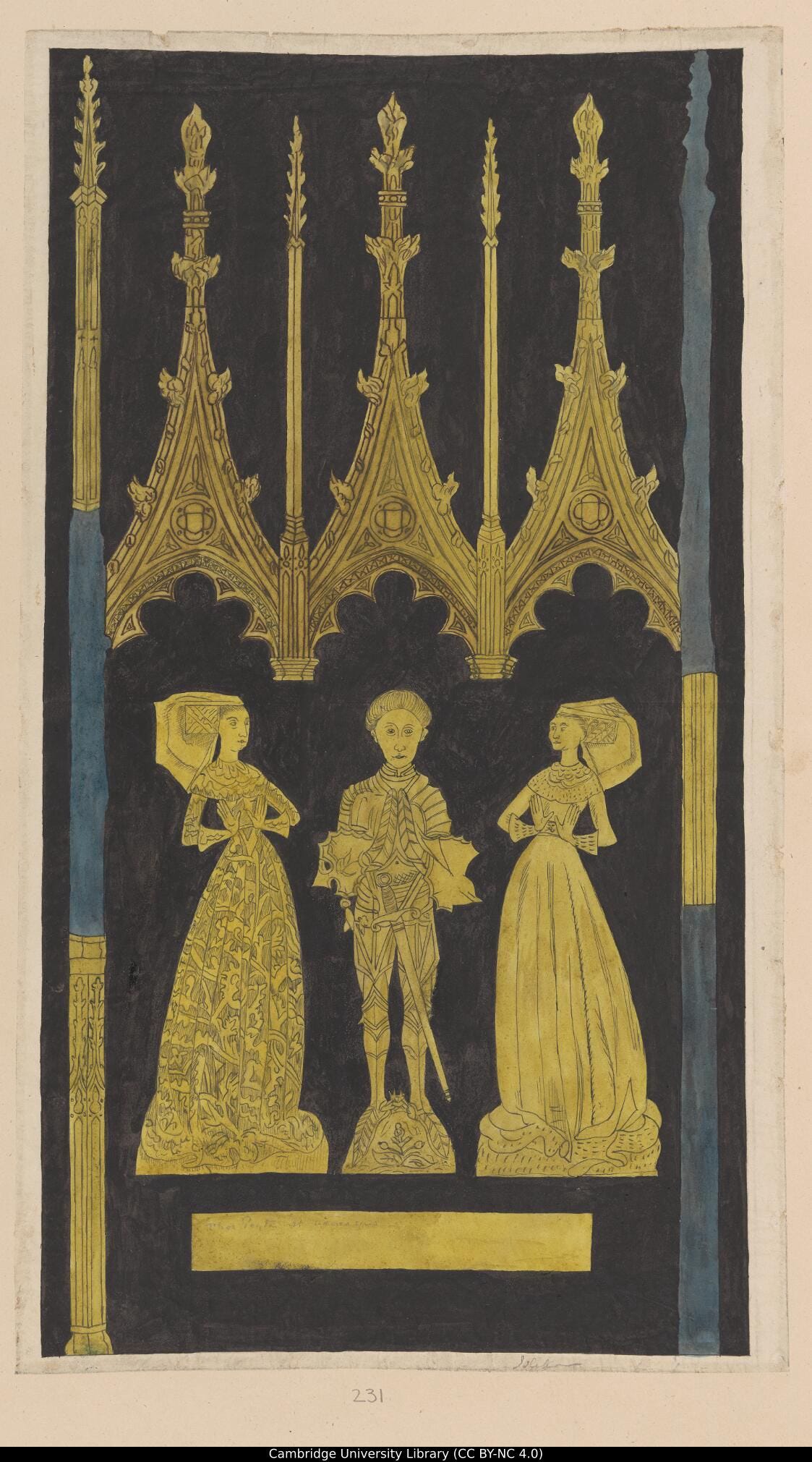
[C19 drawing of the C15 Thomas Peyton brass]
But if I could get over my anxiety about doing something for which I might get told off, I could set off for the day on my bike with my sandwiches and a flask of tea to Ishleham where there is this brass, a memorial to Thomas Peyton and his two fabulously dressed wives who are nearly two feet tall.
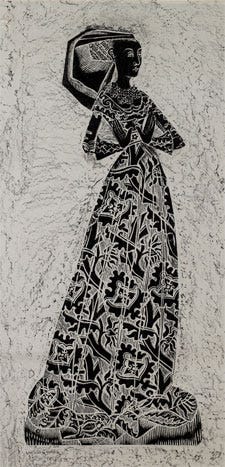
[detail of Margaret Peyton in a rubbing of C15 brass on the lid of a chest tomb in St Andrew’s, Ishleham, Cambs]
One Margaret wears a Venetian brocade dress while the other Margaret is in a plainer dress with a deep fur trimming, and both wear elaborate butterfly headdresses. Sadly, my talents do not extend to drawing a brass as an alternative to rubbing in order to record these superb depictions of C15 haute couture (more on this here).
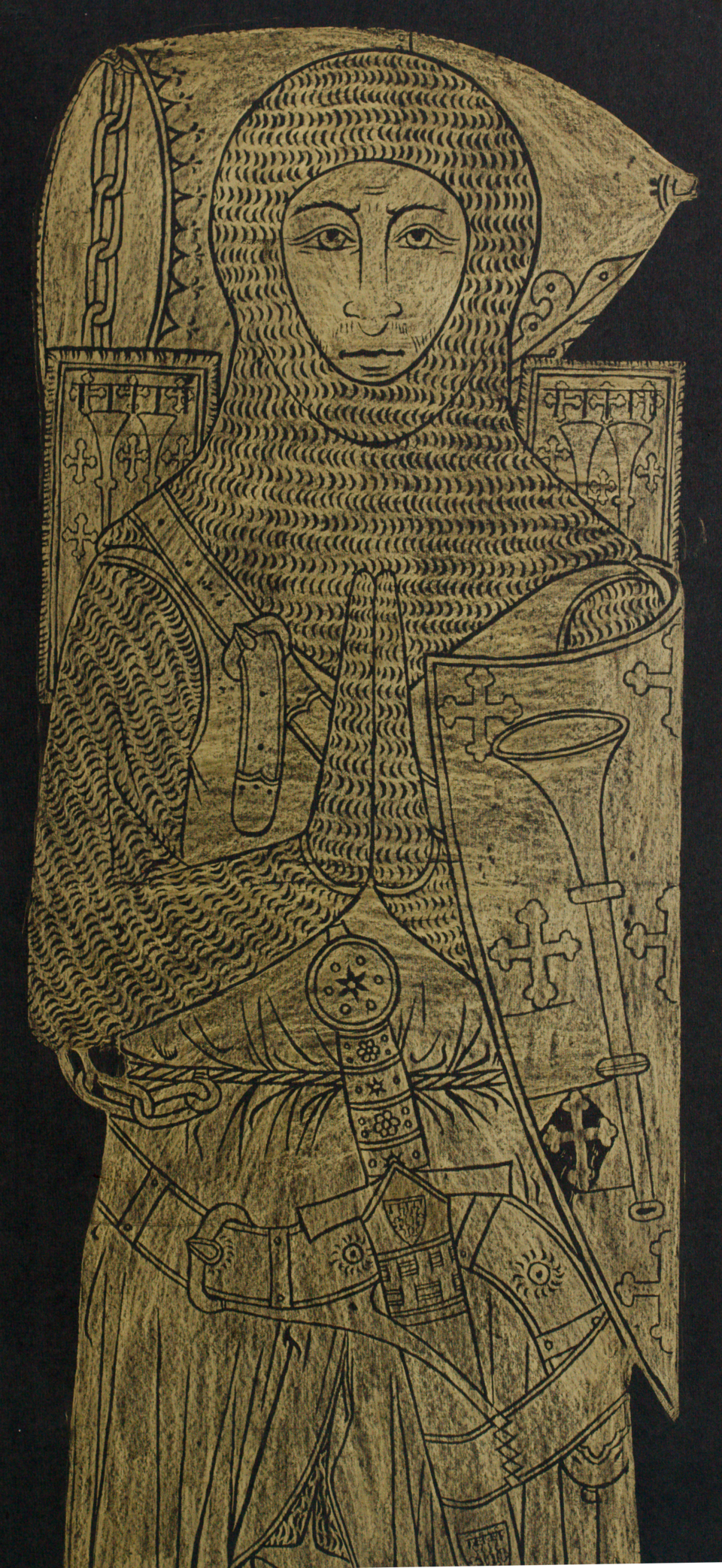
In the summer, we did go somewhere nearer to us to have a look at what is claimed to be the second oldest brass in England. This is Sir Roger de Trumpington (1289) in the church down the road in Trumpington; the rubbing above shows the wonderful details and patterns but it now has a nasty plexiglass protective cover to deter any kind of scribbles and sparkly crayons.
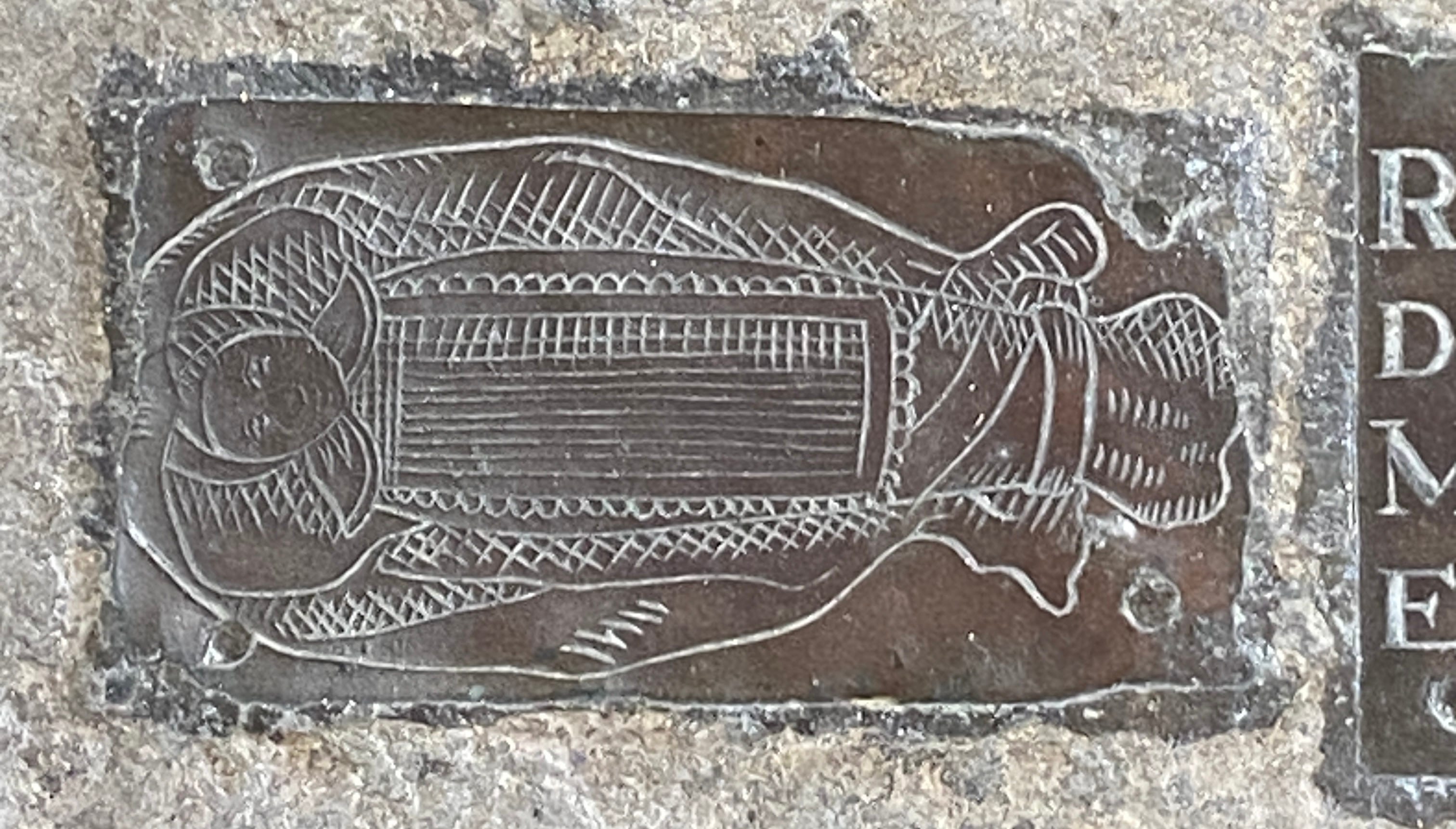
And we also saw the amazing collection of much smaller, early C17 brasses in the Martyn Chapel in Long Melford. These are now cordoned off, so you walk round squinting at the floor to make out the members of the family and the two tiny chrisom/chrysom brasses, brasses which commemorate babies who died in their first month and/or before their mother was churched, so were buried in swaddling clothes. (If the mother also died, then the chrysom is shown as part of a memorial to the mother, often in her arms.)
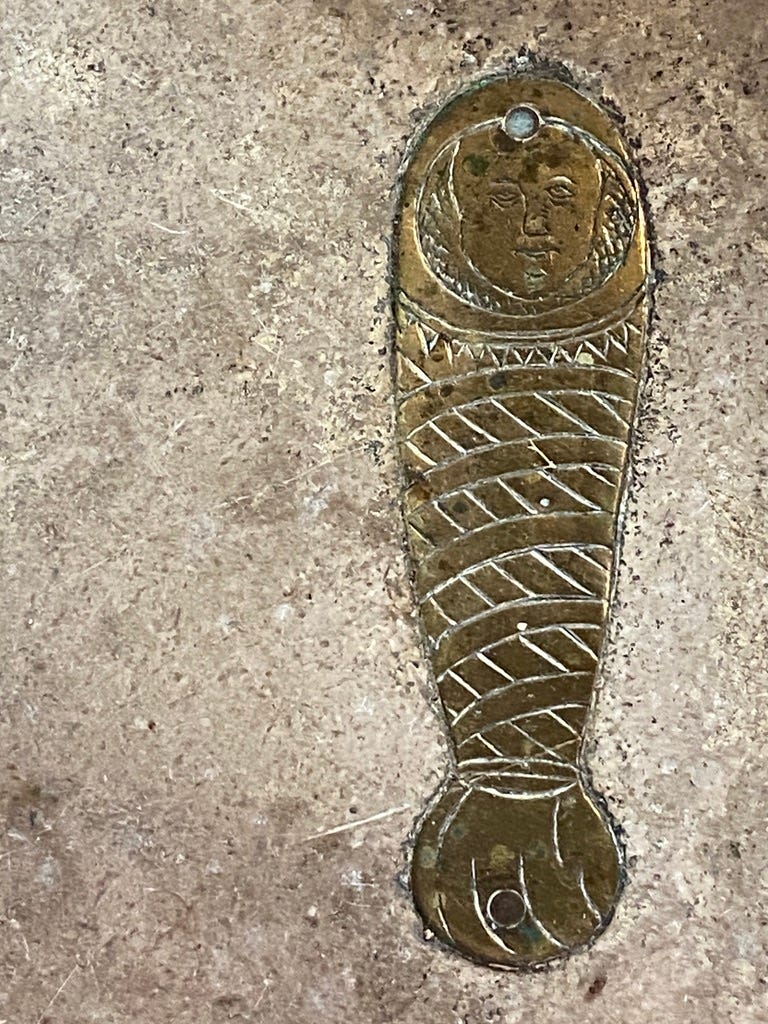
And here’s another, like a little fish, which we saw in Lavenham.
Imagine this sort of memorialisation happening today. I think not. These brasses illustrate just how much our sensibilities around death and the visual culture surrounding it have changed over the centuries.
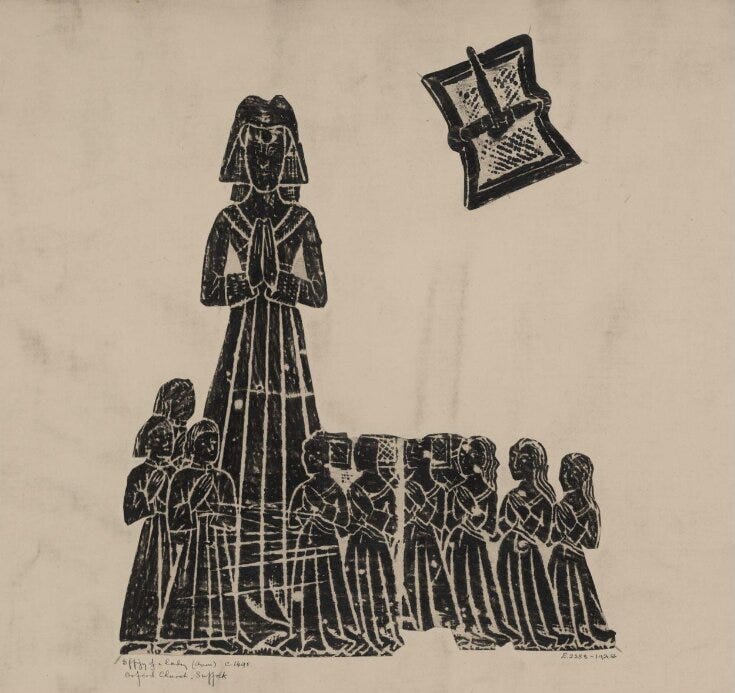
[rubbing late of C15 brass with a lady with 3 sons and 7 daughters in Orford Church, Suffolk]
Also, just how many children people had, and how many died in infancy and childhood. Thank goodness for vaccines.
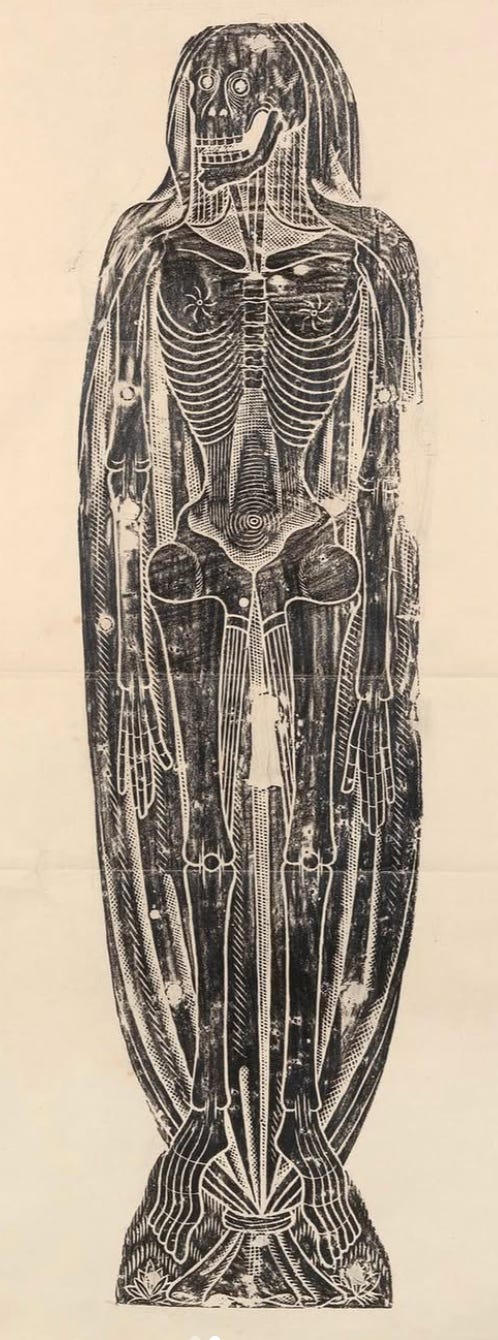
There’s really not a lot of holding back in older brasses, which can sometimes appear quite gruesome and near the knuckle to contemporary eyes. This is a a shrouded skeleton, looking like a medieval X-ray, from a funerary monument (c1485) in Holy Trinity, Hildersham, Cambs. (I really do need to get on my bike and see these fine Cambridgeshire brasses).
It is very much one for Simon Armitage and his new collection, New Cemetery. I heard him discussing and reading from it on The Verb and being very clear that when talking about his father’s death he’d rather people used the words ‘dead’, ‘death’, and ‘died’, and not ‘passing’ or ‘lost’ (“as if I’d let go of his hand in the supermarket”). I, tto, cannot say ‘passing’ or ‘passed away’. Monumental brasses can be equally direct and non-euphemistic, which is perhaps part of their appeal.
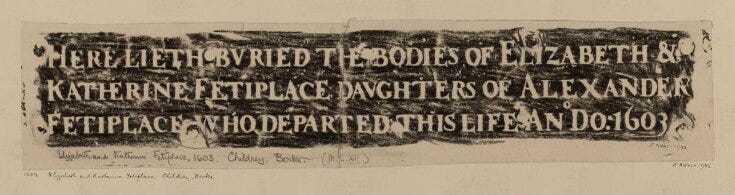
It’s not just rubbings of grandees with ‘de’ in their surname and wimples and corpses and armour and dogs and lions underfoot. People have also taken rubbings of lettering on brass plaques, bells, gravestones, furniture. Arthur Bertram Ridley Wallis (1864-1931) appears to have been exceptionally prolific and inventive - if it came across a textured surface, he took a rubbing - and many examples of his zeal are now in the V&A (as above). He wasn’t always the neatest - this gives me hope - but he certainly got around the churches of Oxfordshire and Berkshire.
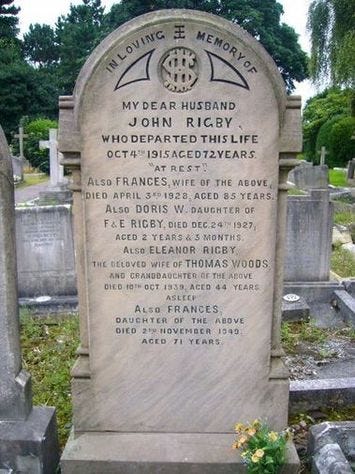
I’m sure he’d have got out his cobbler’s heelball (black wax) and uncoated/draughtsman’s detail paper at St Peter’s Church in Woolton in Liverpool. Not only was it at the church fête here that John Lennon and Paul McCartney first met in 1957, but this is also where one Eleanor Rigby is buried. Who knows if this is what inspired the name in the song, I’m just surprised no-one appears to have done a relief print of the inscriptions to take home instead of a photograph and an earworm.
Happy Sunday!
Footnotes:
The title of the newsletter comes from the poem Church Going (1954) by Philip Larkin who may not have done much in the way of brass-rubbing, but was a great visitor of churches.
I’ve discovered that Cambridge University Library has one of the best collections of brass rubbings in the country, so I have no excuse now to not pursue my new-found interest.
“some brass and stuff” part ii next week.
And if you can't find a church that will allow it, there are coal and manhole covers to practice on. That was quite a craze in my teens.
I used to do this with my Mum, early 70s. I remember the gold wax sticks and a roll of black paper she bought from Heffers. I think it was in Impington church we did rubbings of two large brasses, which were framed and hung on the stair wall.