on not making plans

When we were in Stockholm recently, I decided that from now on I’m officially retired. I announced this to Simon, explaining that it is retirement as in I’ll still be writing and making, but also retirement as I’m ready to just go with the flow, not look too far ahead, not over-commit. Because as John Lennon sang, “Life is what happens to you/Whilst you're busy making other plans”.
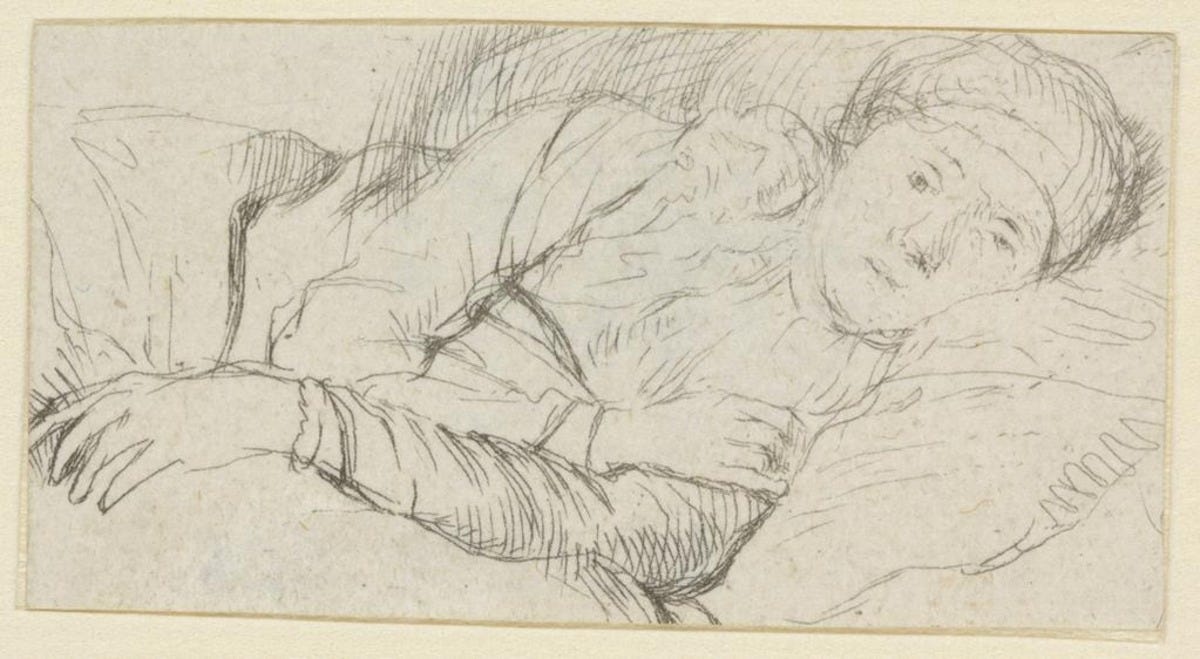
[From a sheet of studies, woman lying ill in bed (1641-42), by Rembrandt]
As if on cue, my body took this literally and decided that it, too, would retire. Just temporarily. So I’ve been ill for two weeks with something that I could have sworn was Covid but wasn’t and then bronchitis, with lots of mandatory bed rest and antibiotics and grapes, followed by this week of extremely hot, sloth-like convalescence.
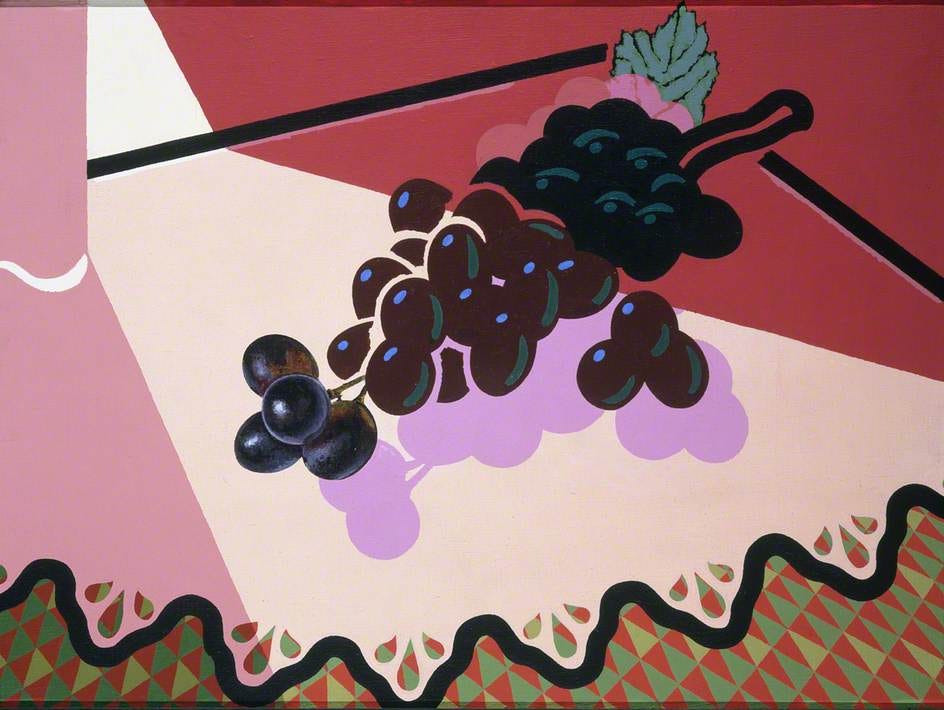
{‘Selected Grapes’ (1981) by Patrick Caulfield]
I’ve said before that I have loved the concept and reality of convalescence ever since I had a planned operation in the school summer holidays when I was ten. I was too ‘mature’ to be in a children’s ward, so I was put in a very hot - it was August and even Stockport was sweltering - women’s ward which was slightly weird but I was too ill to really notice much. I do remember having two new gown-up nighties from M&S for the stay, so obviously dressed the part. I must have looked ten going on seventy.
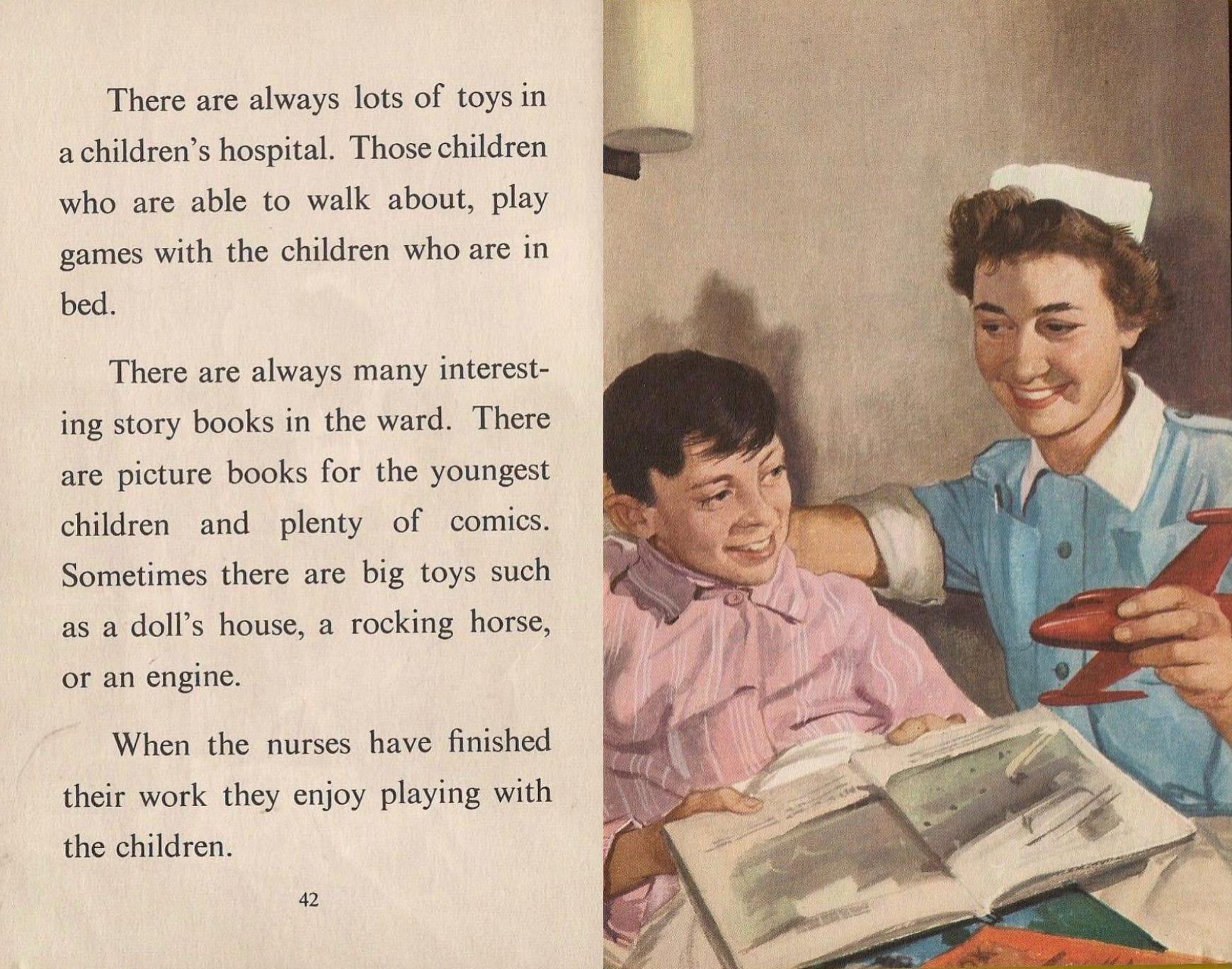
[Douglas Bader’s flying escapades were far more interesting. ‘The Nurse’ (Ladybird, 1963)]
I was also so full of drugs that my Mum remembered arriving at my bedside as I was reading Douglas Bader’s autobiography Reach for the Sky upside down. (Perhaps it was my unusual reading choice - I was obsessed with Douglas Bader - which made them think I’d be better off in an older ward.) Once DB and his legs and exploits had been despatched, a kind neighbour brought me a copy of The Wool-Pack by Cynthia Harnett which immediately became one of my all-time favourite books,
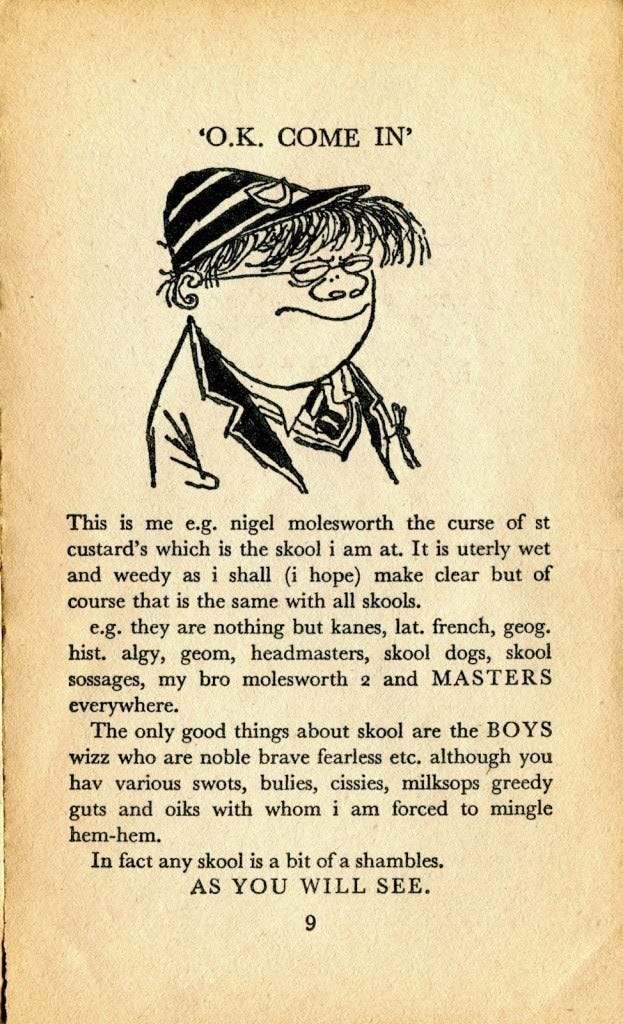
and this was followed by the Molesworth books which made me laugh so much it hurt and I was scared I’d split my stitches.
The best bit about the whole painful episode was that after a week or so I was moved to a convalescent home for a further week. I shared a room with a woman who was forty - not much older than than my Mum - and already a grandmother, something which blew my mind as I’d always thought grandmothers were old.

[‘Gladioli’ (1930) by Adrian Paul Allinson]
The room had big French windows which opened onto a lovely garden (just how I imagine the setting of Someone at a Distance), and an uncle came to visit with an enormous bunch of gladioli from his garden, my first-ever flowers. I still adore gladioli. What was not to like, as they say? It was the most lovely way to be between hospital and home, illness and recovery, being cared for and back being one of four children, three of whom did not give a damn about my drama.
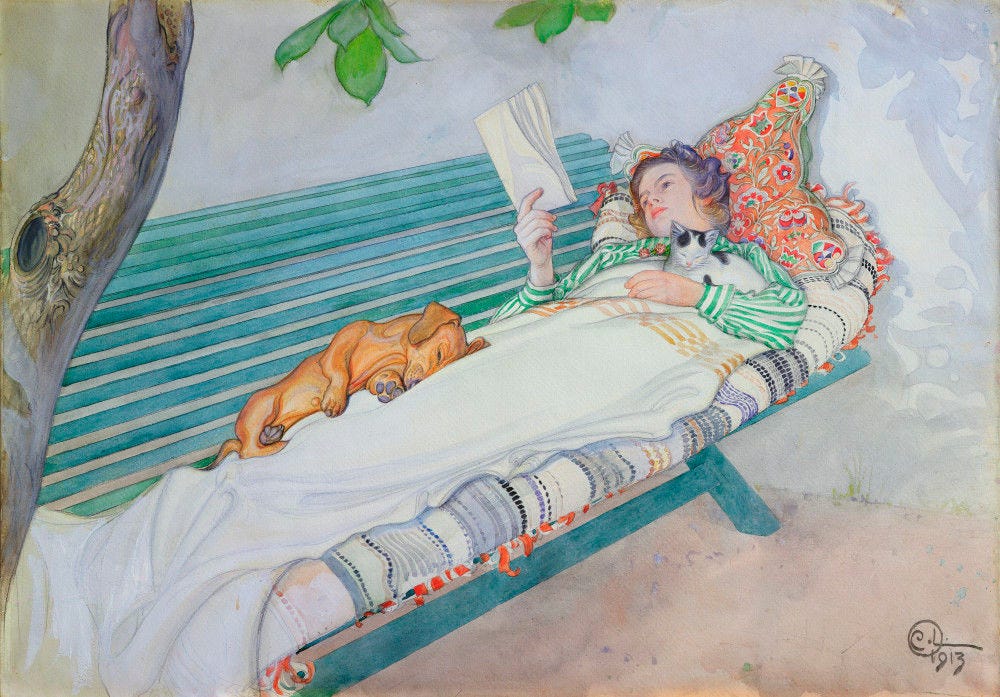
[‘Woman Lying on a Bench’ (1913) by Carl Larsson]
But to go back to reading when ill or convalescing. Together with grapes, it’s one of the few perks. Especially when a screen hurts the eyes, and radio programmes make you fall asleep, and podcasts are too long and gratingly chummy when you’re not in the mood. As a result I’ve read a great deal, as wildly varied as the books I read as a ten year old. No Douglas Bader this time, but a book which featured the author’s step-grandfather Field Marshal Montgomery to whom I am, in an unusual and convoluted way, related by marriage. (My great-grandfather fathered my Nana in an upstairs-downstairs fashion: she was illegitimate but his mother gave her her maiden name and whisked Alice away to an ‘orphanage’ she’d built in the grounds of the Hall. Alice was not the only ‘orphan’ there as my uncle - see above - came a little later. Waldo (a suitably raffish name) died at Gallipoli and in 1927 his widow Betty married Monty.)

[‘The Restless Image: a discrepancy between the seen position and the felt position’ (1975) by Rose Finn-Kelcey, on the cover of Marion Coutts’ book]
I’ve also been immersed in memoirs, having started with On Memoir by Blake Morrison then What Did the Deep Sea Say? by Marion Coutts (beautiful cover, too abstruse for me), Fathers by Sam Miller (a very different world to the one I grew up in even though our family had a very similar secret), and I Remember by Joe Brainard (genius structure, great remembered details).
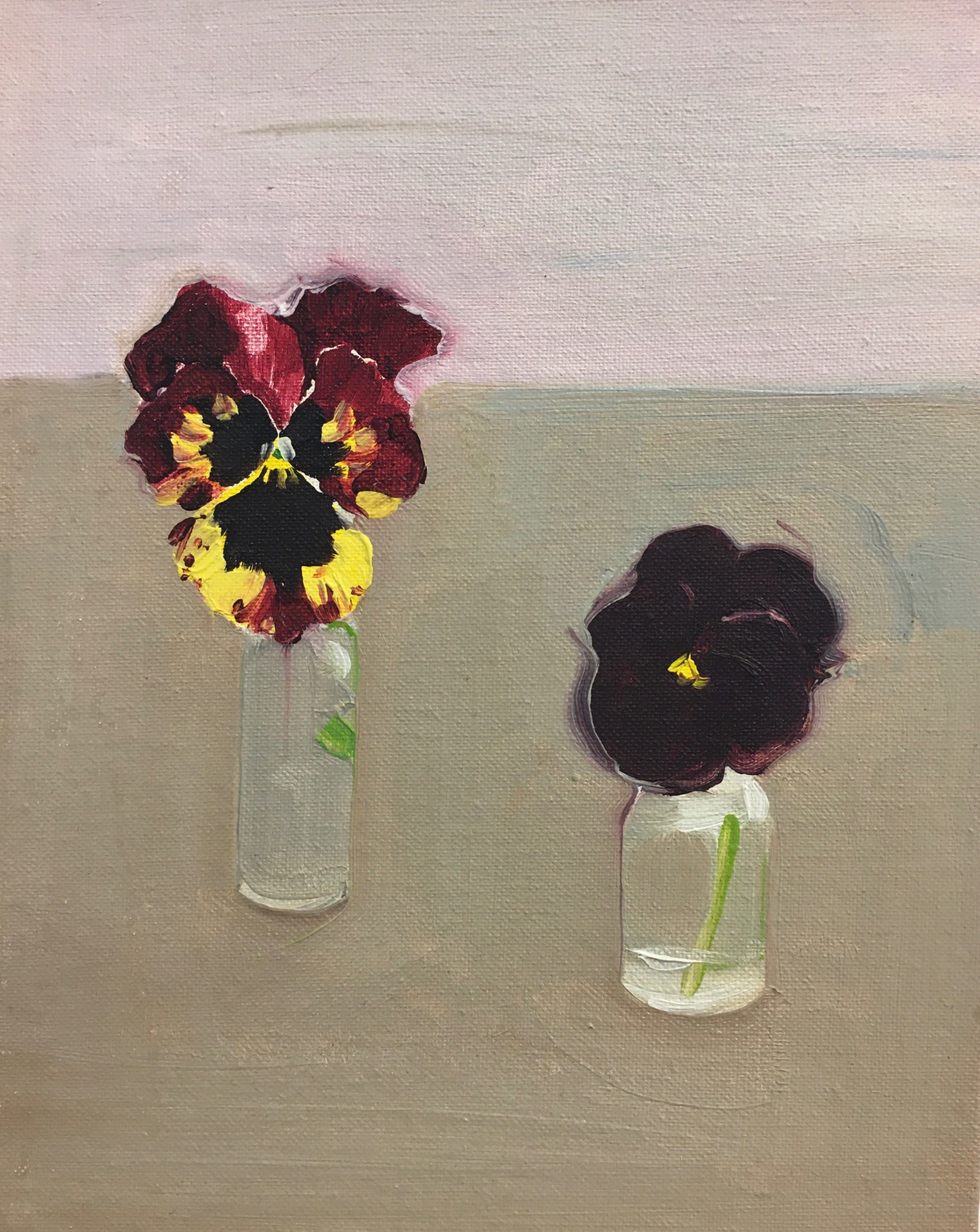
‘Untitled (Pansies)’ (c19700 by Joe Brainard]
On Memoir is to be recommended to anyone who enjoys biographies, autobiographies, memoirs, letters, diaries, and anyone who is writing something along these lines or thinking of doing so. It’s an ‘A-Z of Life Writing’, not only full of wisdom and advice from a tutor/poet/memoir-writer, but also a great source of recommendations (this is where I found Sam Miller’s and Joe Brainard’s books). There’s a lot which resonated with me. Here are a few of my favourite bits:
“There’s no sin in honesty; don’t be afraid of having your say”
“I’m interested in the idea of confession as a desire to redefine what’s shocking - to show that what society deems shameful…is actually normal and worth attending to rather than hiding away”

[seeing in: Philip Johnsons’ Glass House (1948-49)]
“no one wants a memoir with net curtains: we do want to see in”
plus three loud cheers for his dislike of the use second person narrative, ‘you’ rather than ‘I’. As he says, “Speak for yourself! Don’t affect to to know how I think and behave! Leave me out of it!” and quotes Morven Crumlish: “You are having ideas, actions and habits attributed to you, with the understanding that you are in the same clique as the writer.” It’s precious and affected. And over-used (good pun haha).
And when my eyes can’t take more pages and print, there’s been the World Cup.

Not so much the actual football, more finding out about the enormous American stadia (can you see anything at all from the top tier or does it all look like a game of Subbuteo?), countries like Cape Verde and Curaçao, the philanthropy of Mohamed Salah, the art of taking penalties, and enjoying the fabulous amount of neon colours being worn. Electric fuchsia kits and boots - oh yes, please.
Finally, despite reducing my screen-time, I did of course read every single comment on last week’s newsletter as well as the emails sent separately. Thank you. They made it worth sticking my neck out. It was so good to read your stories - all those tears on the day after the Brexit referendum* - and to feel surrounded by Europhiles.
Happy Sunday!
*which was only ever advisory and not legally binding, and no I cannot let go of that, even after ten years
Just wonderful, even more than usual, and I do hope you completely recover at a pace that you are happy with. I was ill a great deal as a child, rather seldom thank goodness as an adult, but I have a very specific fondness for the mornings I wake up and realise that I am better. And talking of waking up, one of the worst was turning on the radio the morning after that wretchedly ill-conceived and hopelessly managed referendum and bursting into tears at the result. The utter carelessness of it all!
Oh, and I must mention that footie photo: I am famously (famous in my family, I mean) averse to the beautiful game, and not keen on sport on any kind, but my eye had also been caught by that fuchsia picture. Not only the gorgeous colour, but the perfection of the moment, the apparent impossibility of the stance: breathtaking. And congratulations on your retirement!
Sorry you’ve been unwell and hope you feel better soon. I had acute appendicitis when I was 7 and spent some time in hospital after an emergency operation. The nurses were very worried about me as I didn’t want to get out of bed and spent my time lying down reading. My mother was a lot less worried as she knew that was my way of recovering. The Midnight Folk by John Masefield and The Weirdstone of Brisingamen by Alan Garner were my drugs of choice then but it could just as easily have been Cynthia Harnett though Ring Out Bow Bells gave me nightmares!