jolly jugs

In my early teens, I thought I’d like to be a collector. The problem was that I didn’t know what to collect and had no money, so my ambitions were soon quashed. Instead, I bought books, which seemed quite radical as I’d been trained to use the local and school libraries and there weren’t a lot of books at home (my Mum and Nana both read masses, always library books).
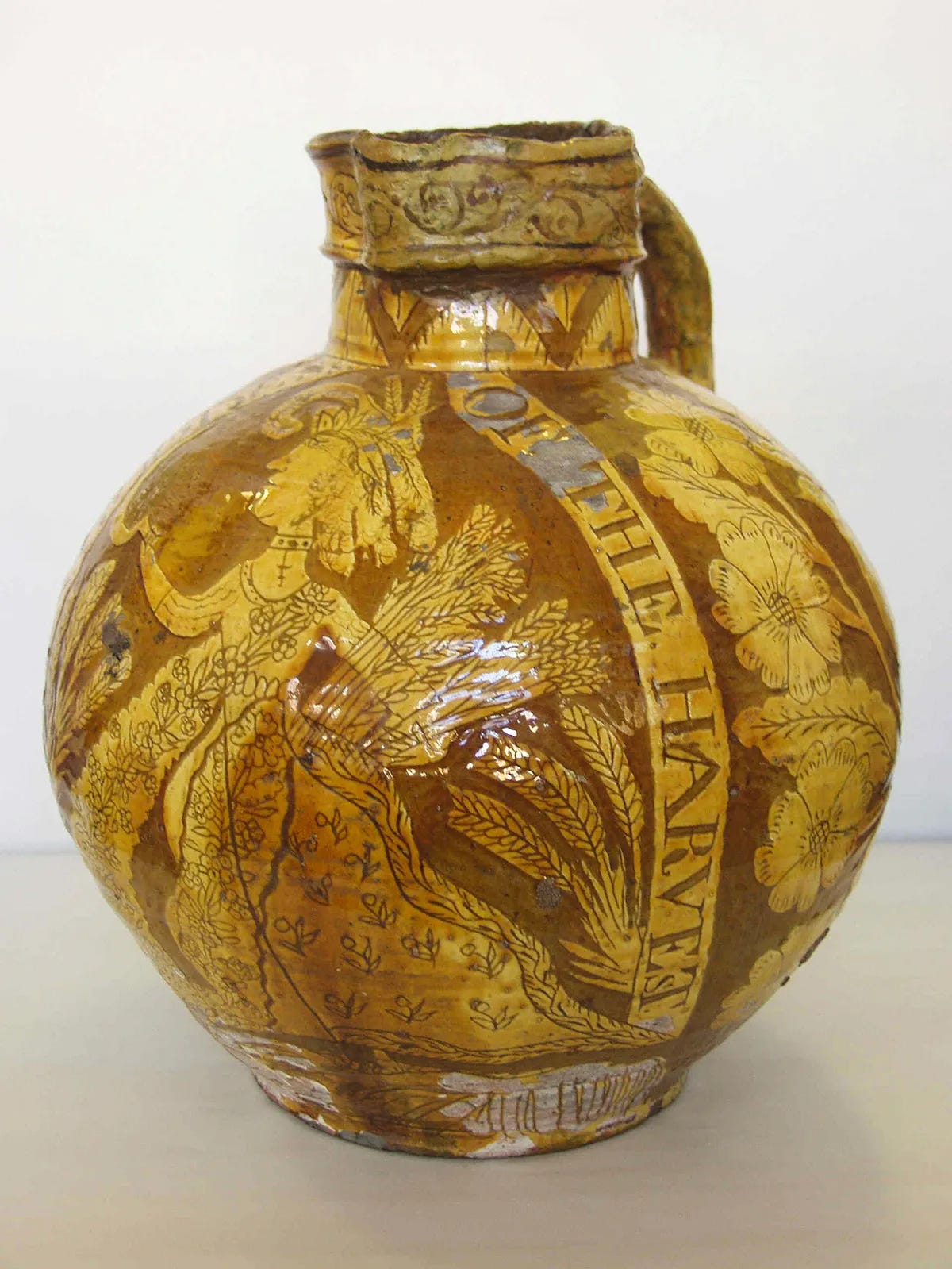
[harvest jug featuring Ceres, goddess of agriculture, 1797, in the Bruton at Bideford]
What I didn’t realise is that I could have collected something cheap and ordinary: sardine tins, paper bags from shops, fruit labels, train and bus tickets, even stamps (I did try that but disliked the fiddliness of sticking them in my album and gave up after a few German stamps from my pen-friend). I’d have loved to know about collections of ephemera and folk art like those of Peter Blake and Enid Marx and could have done with someone like Jake Tilson who has amassed an incredible amount of everyday objects to use in his art, books, and installations, to show me the way.
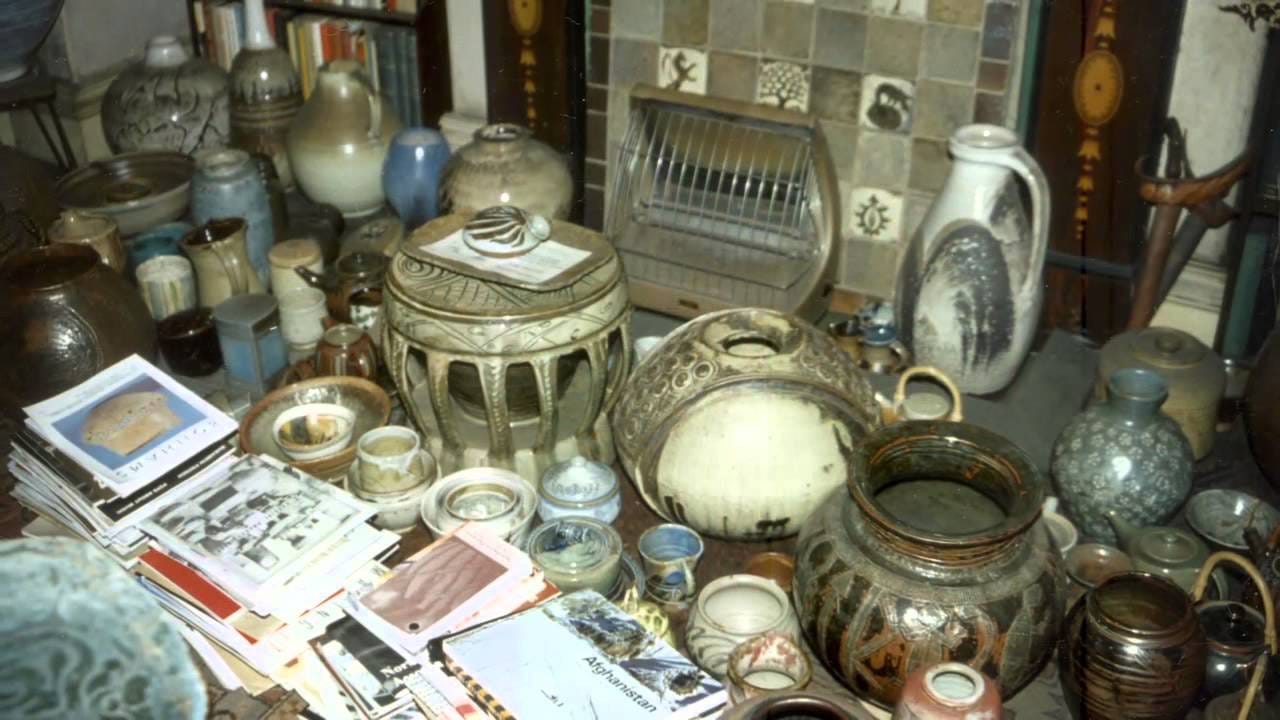
[Some of WA Ismay’s collection of 3,500+ pieces of C20 studio pottery, now at York Art Gallery]
In many ways, not being a collector isn’t a bad thing. I suspect it can quickly become an obsession, and when I see photos of people’s huge collections which have taken over their living spaces, it makes me feel extremely uncomfortable.
But, and of course there’s a but, I still wouldn’t mind a little collection. If I had the means, I’d quite like a few jugs. These would not be fine, precious jugs from the likes of Sèvres or Meissen, but commonplace, characterful, loved, used, and functional jugs from provincial potteries.
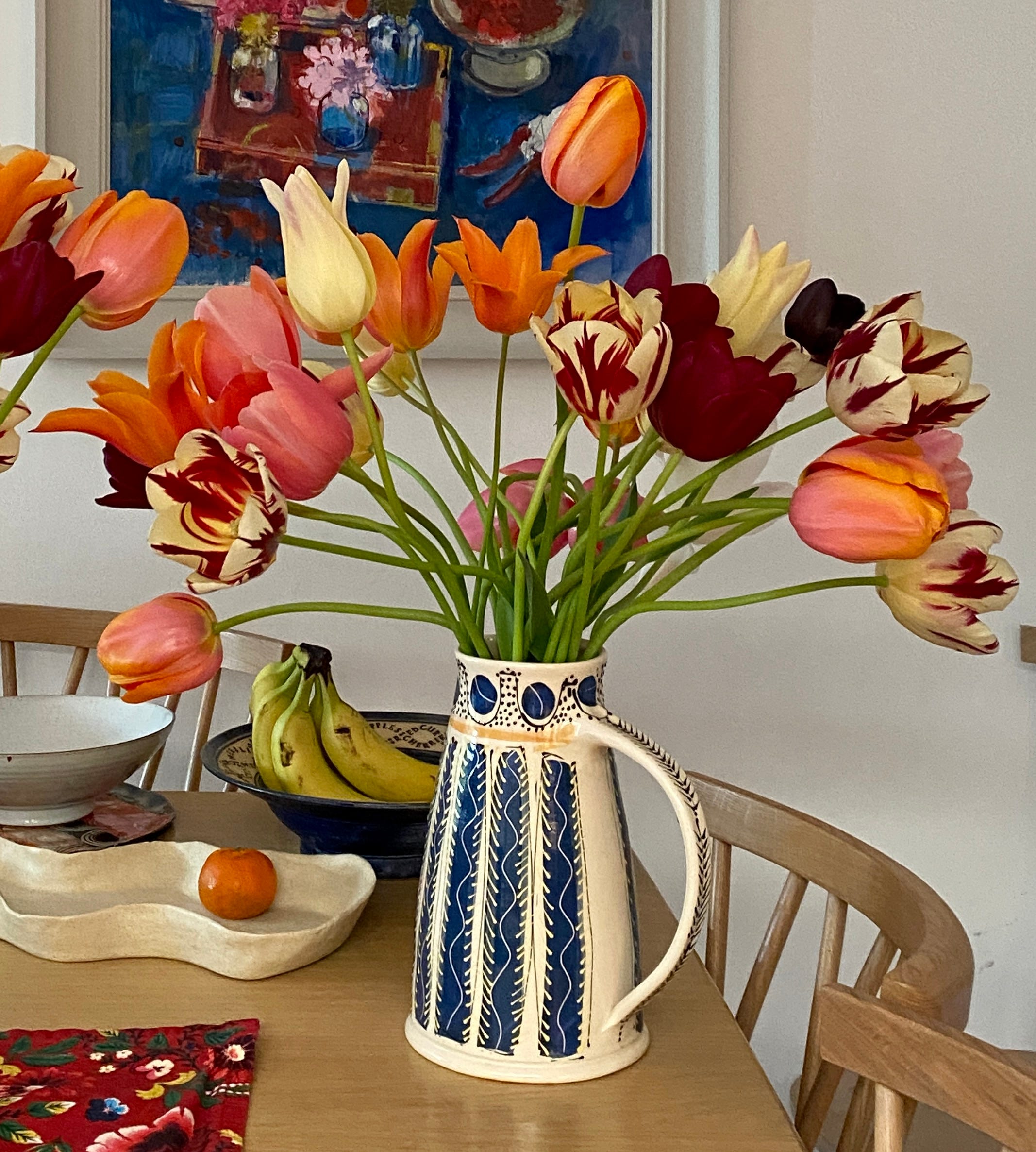
[jug by Irena Sibrijns]
I’ve come to prefer jugs to vases. A jug has more than one use whereas a vase can really only ever be a vase, even if it’s holding paintbrushes or rulers. A jug can be used for “frothing milk” as in novels by George Eliot, or lemonade or custard or booze, but it can also moonlight as a receptacle for flowers (and lots more). I also like the way a jug can have a mouth, lip, waist, shoulder, neck, belly, foot, and at least one arm; it has so much more character than a vase. It is a sociable, sharing vessel, as Ezra Shales points out. He has written published a wittily titled book on ‘pitchers’ and the article also includes many other interesting readings of jugs. (Having said all this, I have a few very precious-to-me vases which are therefore excluded from my sweeping statements; these include a concrete one which was a present from Tom and Zoë, and several made by Phoebe.)
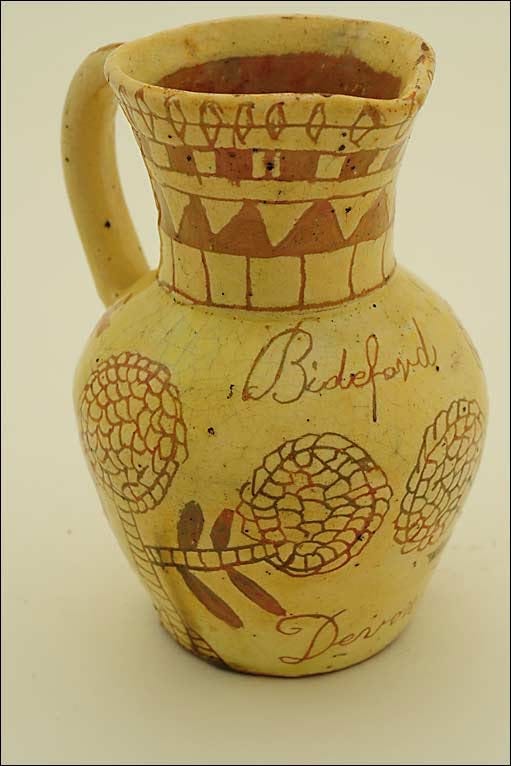
A while ago, we stayed in North Devon and I became fascinated by the history of harvest jugs made locally, fine examples of which we saw in the brilliant Burton at Bideford, in a town long associated with traditional slipware pottery.
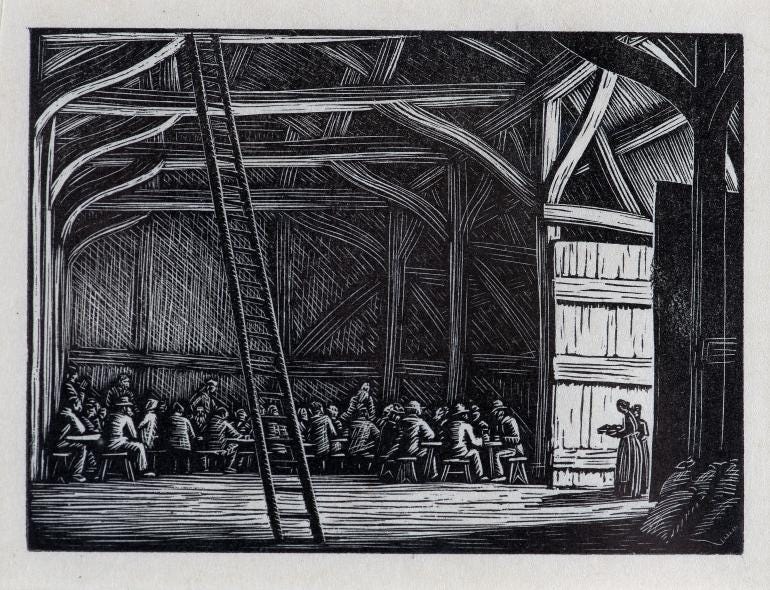
[‘Harvest Feast (Farmer’s Glory)’ (1934) by Gwen Raverat]
These big earthenware jugs made from local red clay were used to hold large quantities of cider or ale at festivals and feasts, and had images, texts, and commemorative details incised or scratched into the pale clay slip by the sgraffito method. They are the kind of thing I’d like to think appears in Adam Bede:
“But now the roast beef was finished and the cloth was drawn, leaving a fair large deal table for the bright drinking-cans, and the foaming brown jugs, and the bright brass candlesticks, pleasant to behold. Now, the great ceremony of the evening was to begin—the harvest-song, in which every man must join.”
I’m fussy, though, and wouldn’t want a harvest jug just for the sake of it (a problem with a collecting obsession, I imagine), one which is over-decorated and/or badly worn and difficult to decipher, as some of the old ones can be.
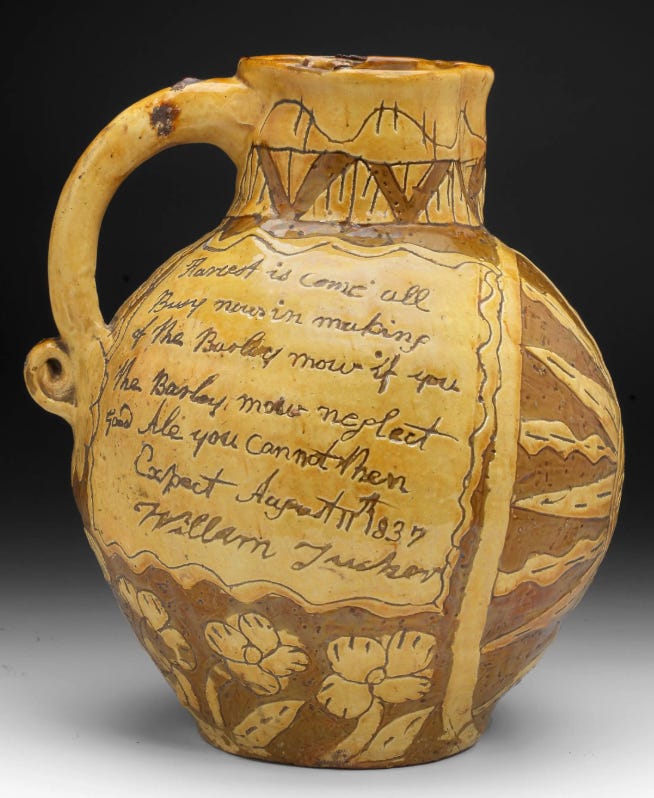
No, I’d want the very best, including a good example from North Devon, like this 1837 jug (sold for £3,375 in 2012) which, as this article says, was “crafted with no eye to future value and simply expressed the sentiments of the age”. All the more reason to like them.
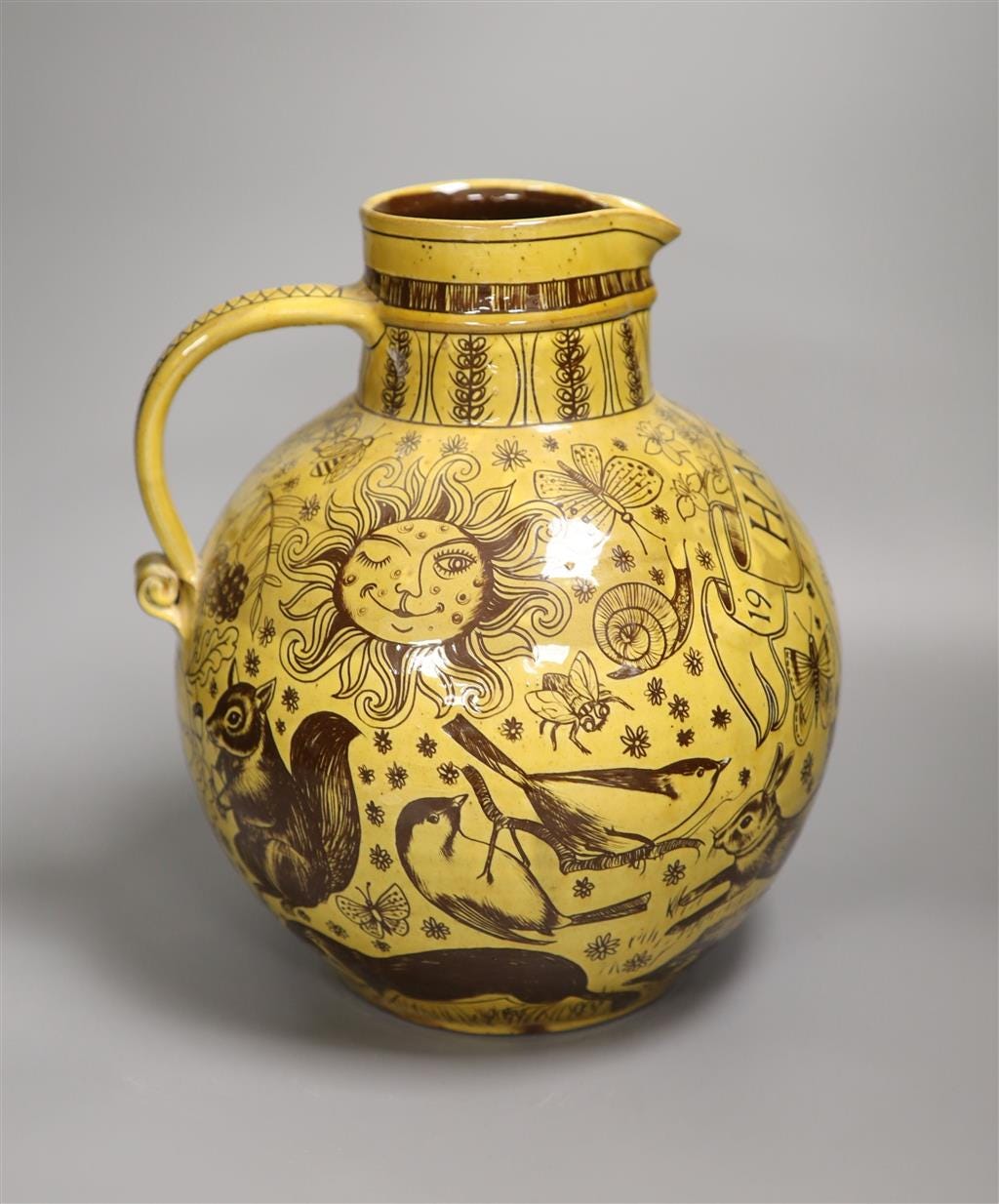
I’d also have one by Harry Juniper (b 1947) who is still at work in Bideford,
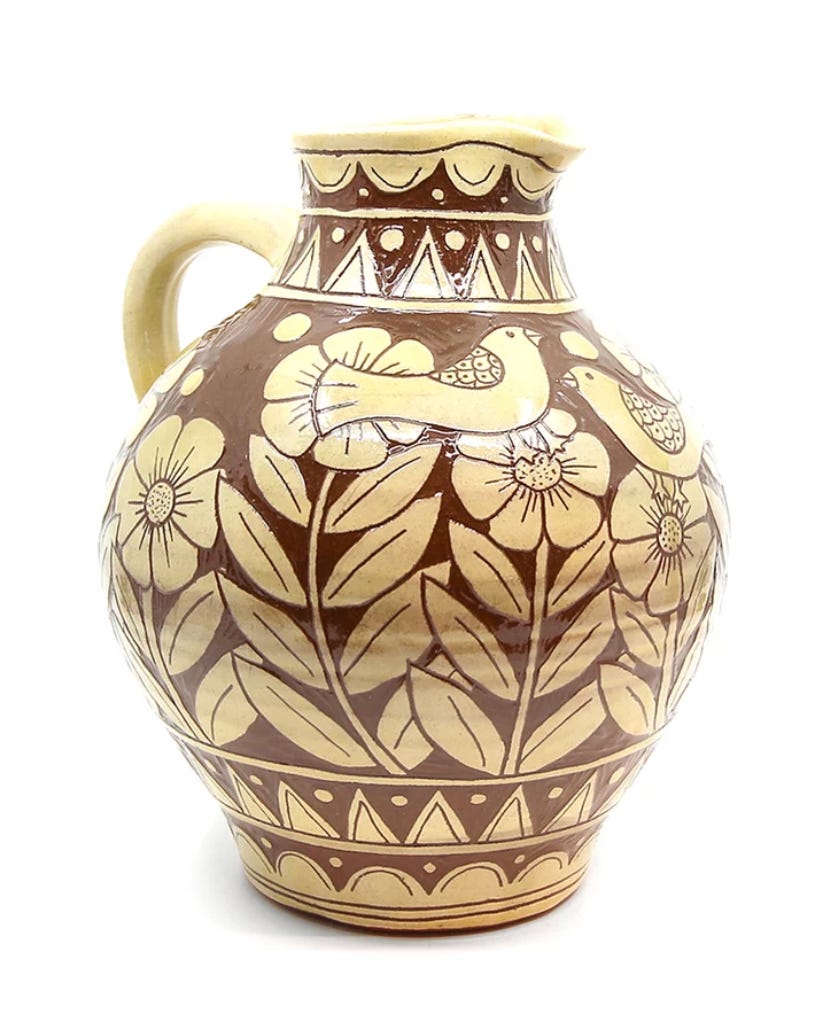
and one by Christina Serra Delmar, a contemporary maker who uses the term
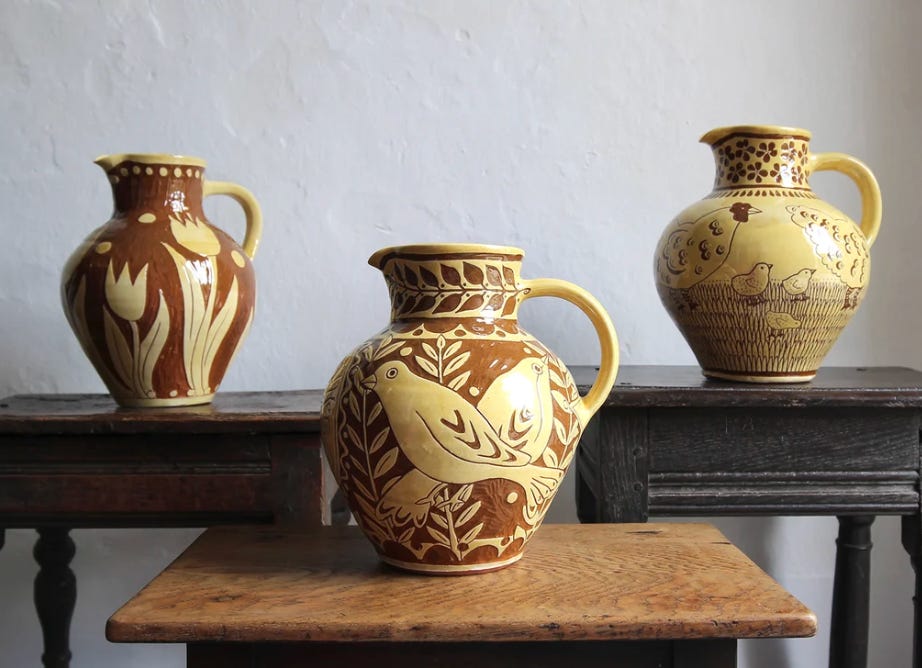
“harvest jug” quite loosely but marries the traditional techniques with beautifully clear and graphic patterns and images. It’s not a lot to ask - just a few thousand pounds - for this part of my jolly jug collection.
Because I wouldn’t be a harvest jug purist. I’d also be happy to add in a few other jugs which were once cheap and commonplace, but which are now also way beyond my means. Sunderland lustre ware appeals because the lovely range of iridescent pinks and bright, jolly transfer colours,
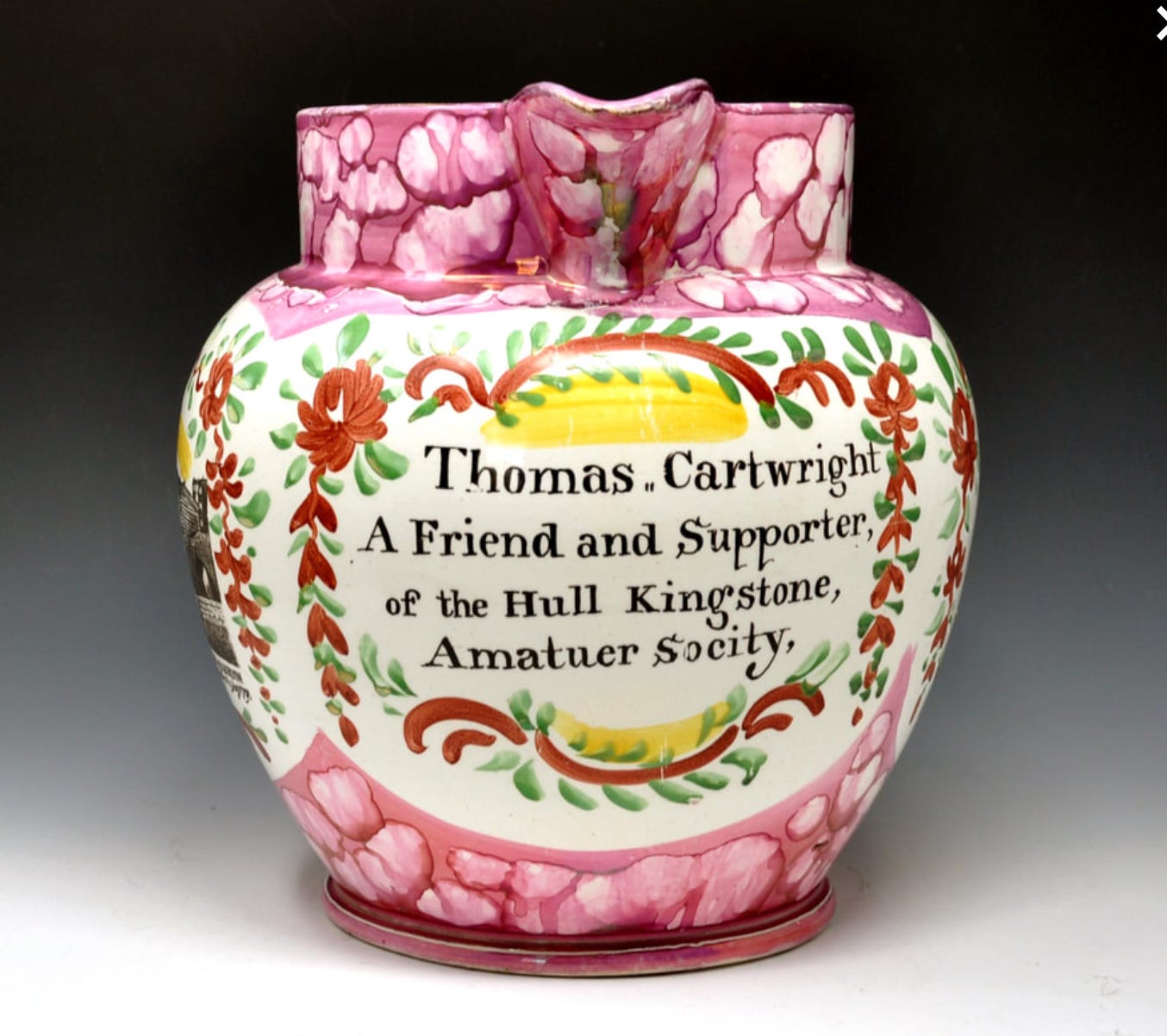
the terrible spelling mistakes, the things people commemorated in the past -
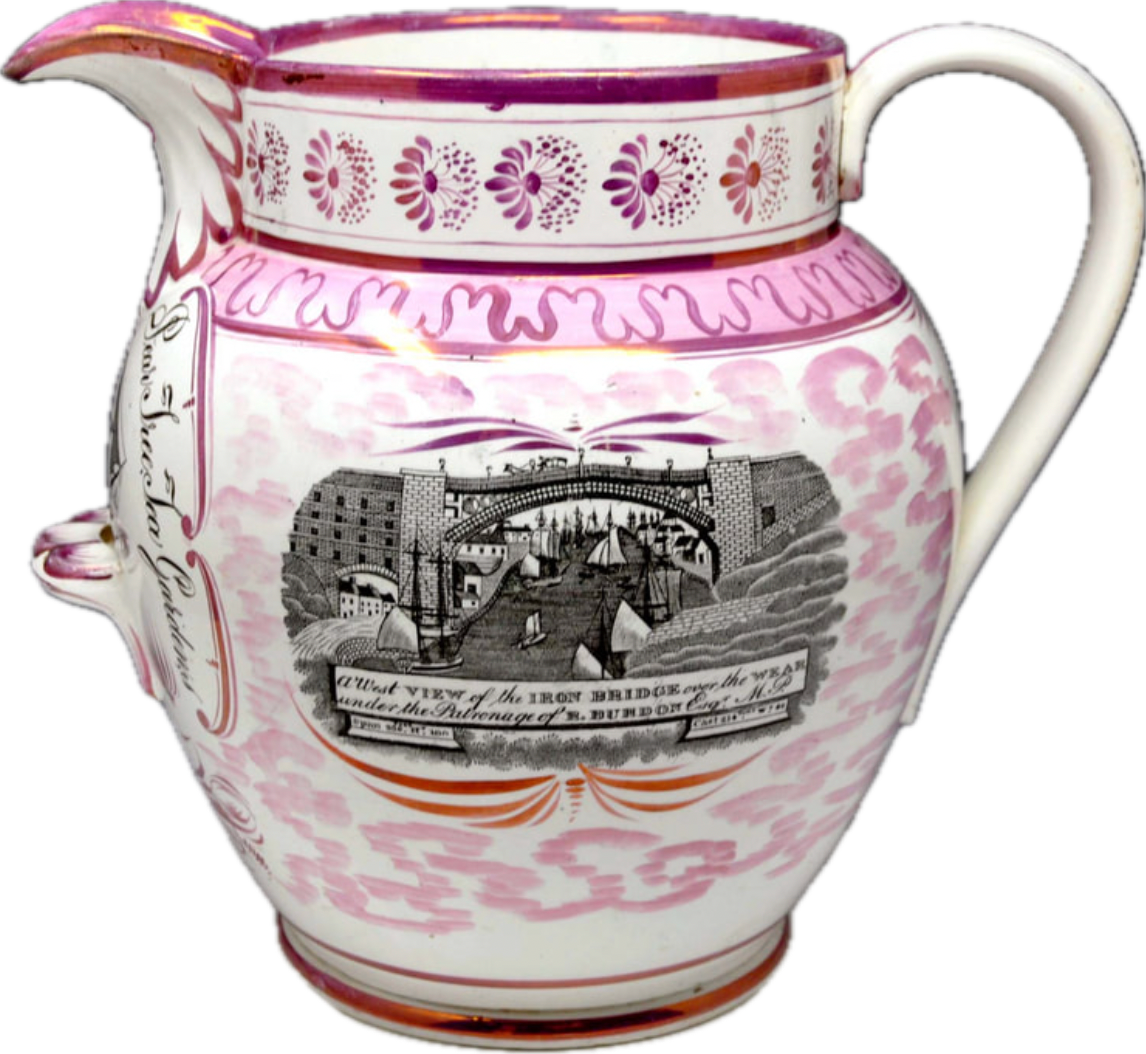
lots of railways and bridges and ships, this being Sunderland and the Tyne after all - and the nice bulbous shape of the jugs. Although Sunderland at one point had sixteen potteries producing lustre ware, it later became a style rather than a specific origin.
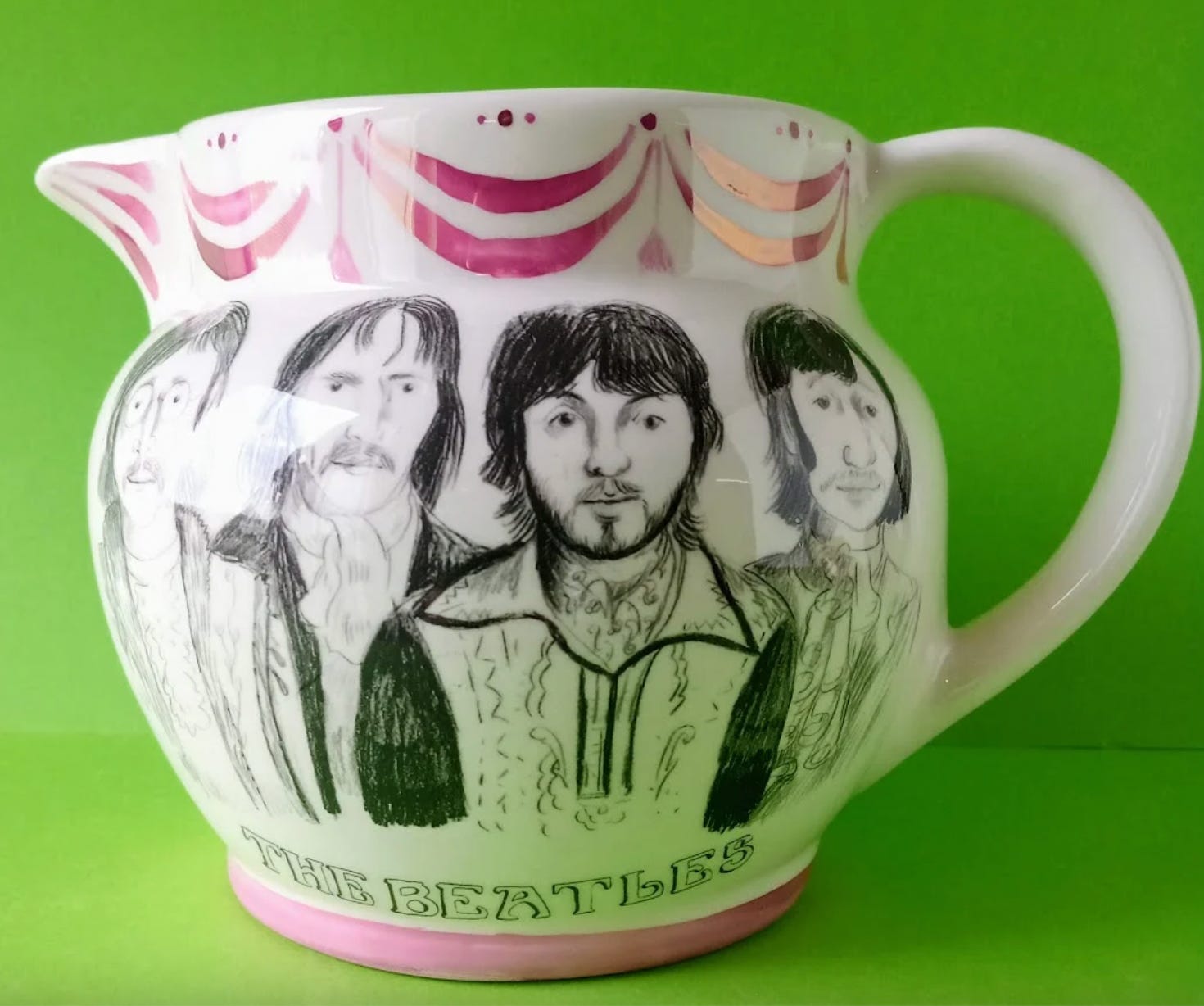
This, too, has been reinvented for the modern age by Sussex Lustreware.
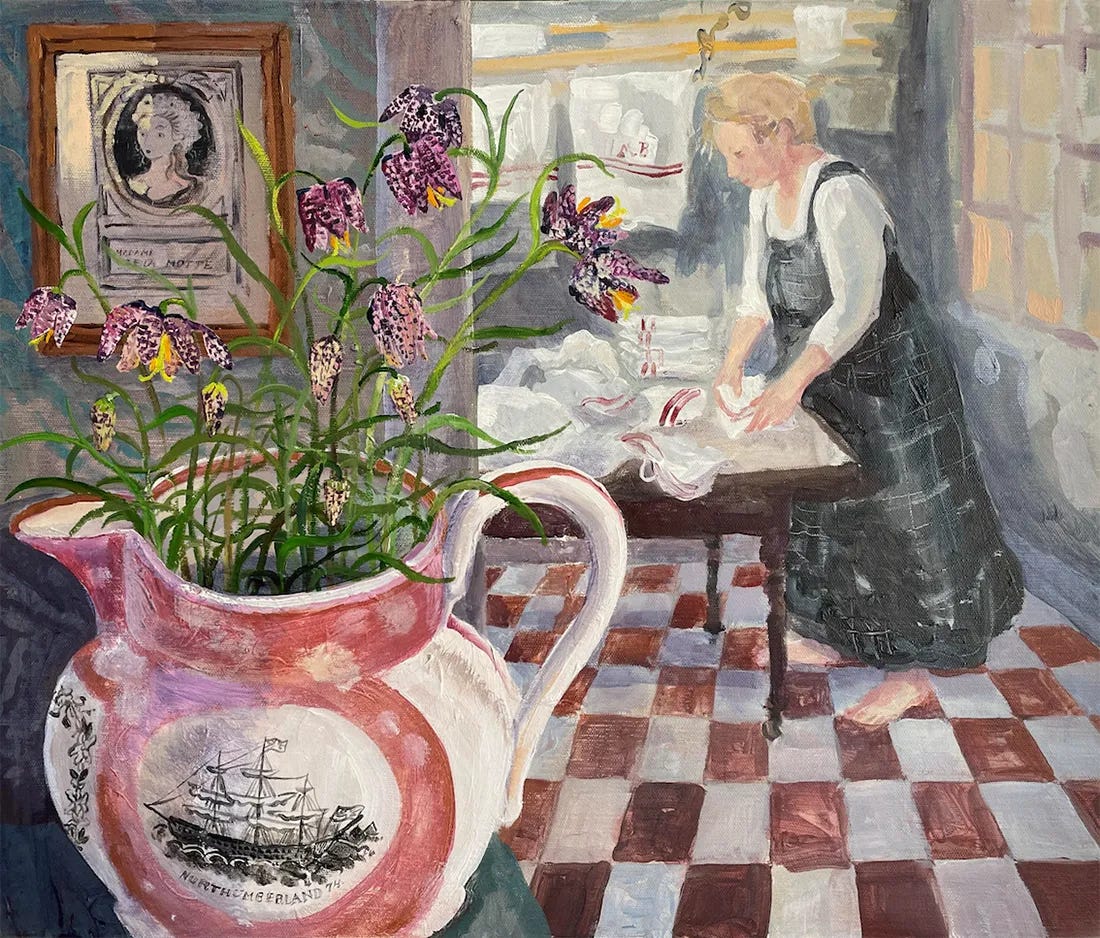
[Folding Tea Towels (2025) by Brita Granström]
Brita Granström often includes a traditional lustre ware jug in her lovely domestic images. In an ideal collecting world, these would also be a part of my collection.
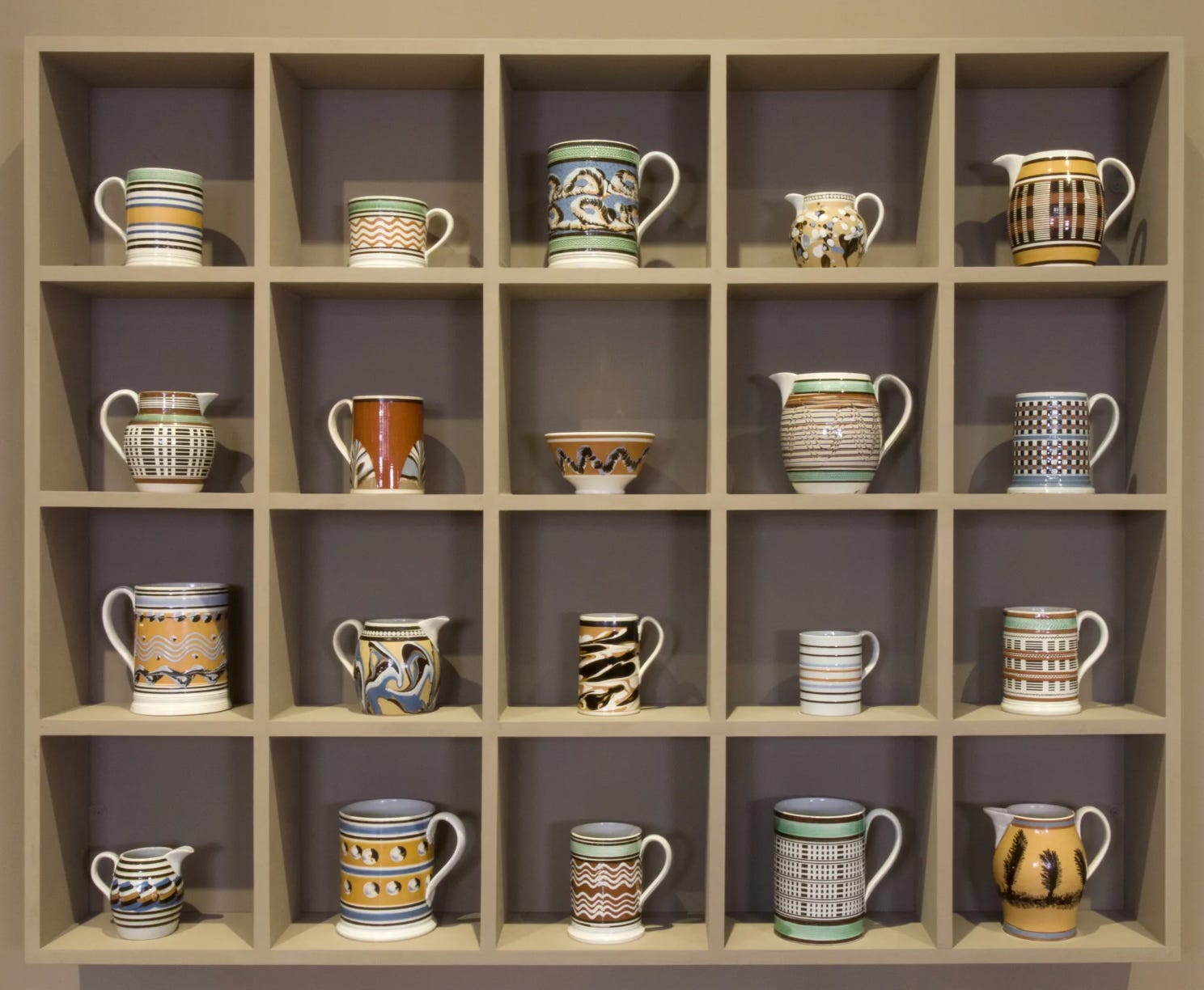
[Lyndsey Graham’s collection of mocha ware, as seen in her gallery]
I’d also love a shelf full of mocha ware jugs (and mugs). Mocha ware has a huge range of decorative possibilities, so there is no one particular type I’d collect, although I’m drawn to the cat’s eye circles, the organic and no doubt unpredictable dendritic or seaweed patterns, the stripes, and the classic palettes. It was mass-produced, utilitarian pottery, and the mugs and jugs were used in Victorian pubs and taverns; many surviving examples show serious signs of wear with cracks and chips, so those in good condition are no longer cheap.
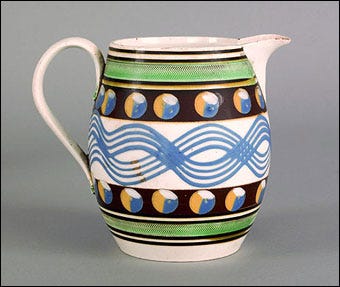
It originated in the Staffordshire potteries in the 1700s, and the name derives from the pattern that which looks like the natural markings on the semi-precious moss agate, which was known at the time as ‘mocha stone’ (it also looks like a tree, hence ‘dendritic’). The word ‘mocha’ applies only to the decoration, so the jugs I’d like to collect could be both creamware - another collecting possibility - and mocha ware.

[c1820]
Sadly, it is also currently the most sought-after of the three jug types I like so much, and is being collected by artists, designers, and people with money and good taste who are sending the prices sky-high. (In 2023, I went to this exhibition of very beautiful mocha ware in fine condition and tried to estimate its value. ‘A lot’ was all I could come up with.)
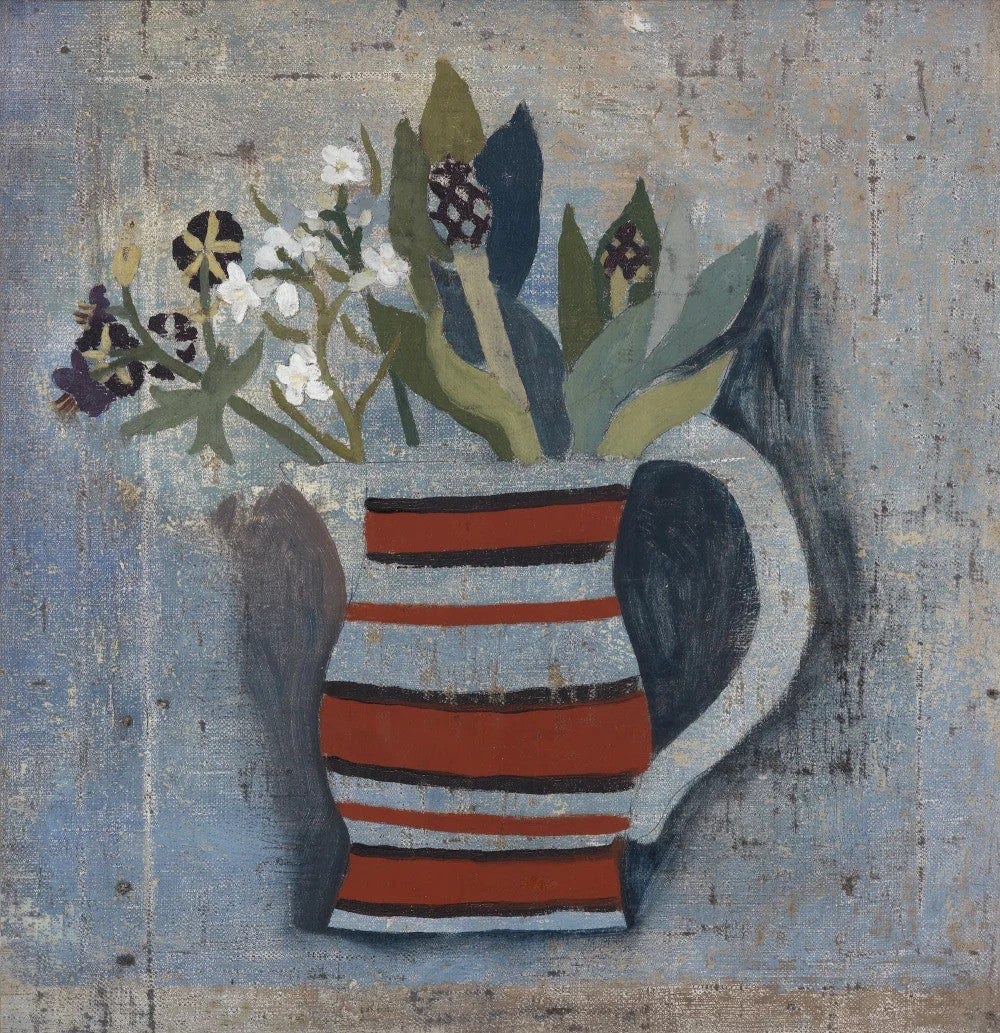
Ben Nicholson had several jugs in his studio which appeared time and again in his paintings (there’s a useful Pallant House exhibition publication), including this early c19 mocha ware jug as seen in Striped Jug and Flowers (1928). I imagine there must be enough material to write an extensive ‘jugs in paintings’ book which would be a wonderful read.
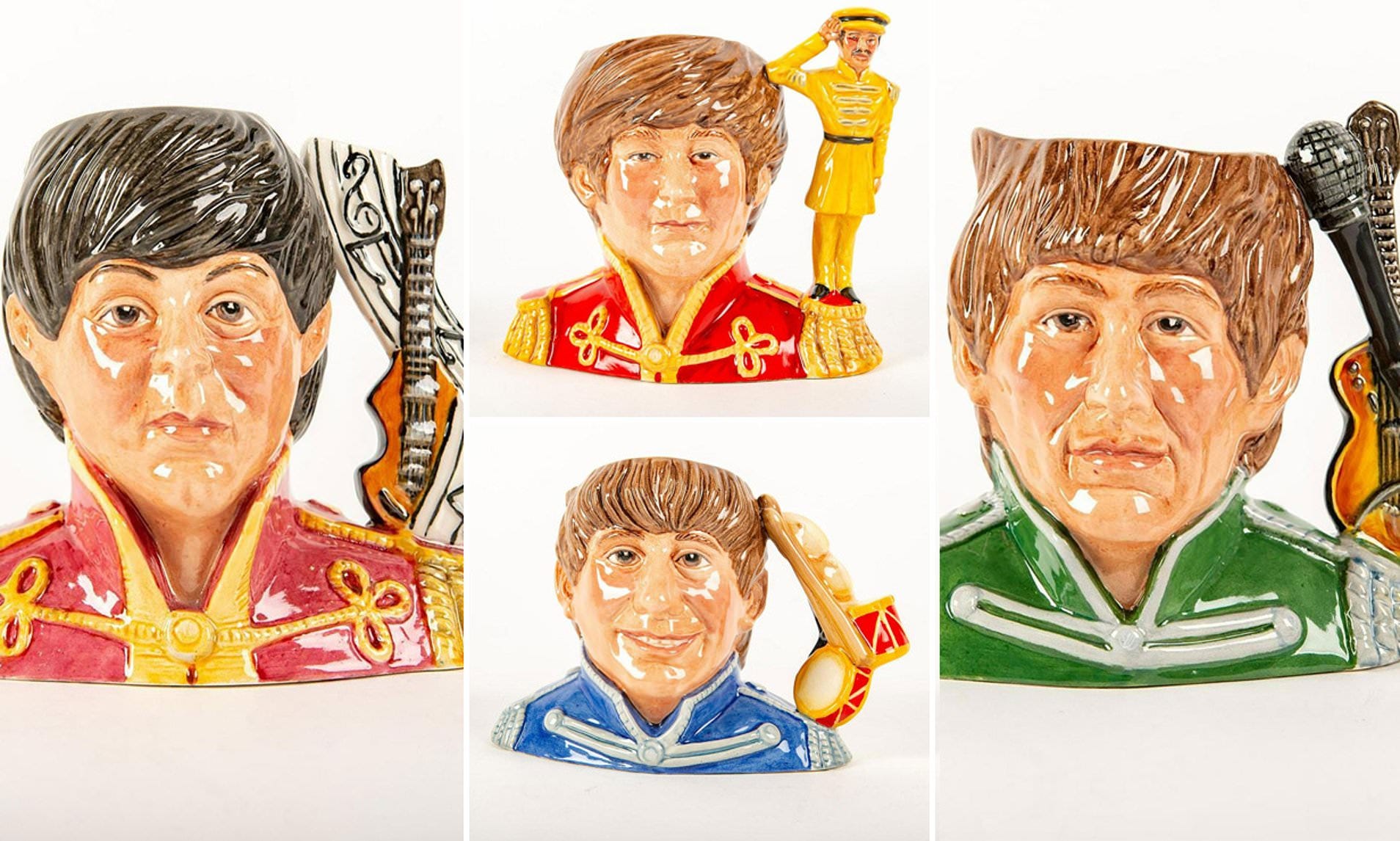
There is, though, one type of jug I would not collect, and this is the Toby jug. Specifically Beatles Toby jugs, of which there are many, too many some might argue. These are by Royal Doulton and the four of them sold for £6,000 in 2021. I need say no more. Except that, clearly, I was never cut out to be a proper collector.
Happy Sunday!
From now on jugs will always be jolly jugs to me.
Having spent 15 years of my life (1st teaching post, marriage and 2 children born there) in Sunderland, I had to buy a piece of Sunderland ware. One side displays a view of the Iron Bridge of Sunderland and a number of sailing ships heading to the mouth of the River Wear. The other side reads a pithy little poem:
The world’s a city with many a crooked street,
And death’s a market place were (sic) all men meet:
If life was merchandise which men could buy,
The rich would live, the poor alone would die.
Sadly it had a large hairline crack when I bought it over 35 years ago, so has always remained an empty jolly jug.
I, too, dislike Toby Jugs. However when my Dad died in 2022 I kept one of his two. It sits at the kitchen window, full of rubber-ended pencils for the daily crossword, and every time I look at it I think of my dear Dad. I love his Toby jolly jug.
Thank you for a jolly good read, Jane. As always.
Thank you for this interesting article Jane, speaking as a fellow jug lover I found it fascinating. Once again a good read!